
How to Choose the Right AC and DC EV Chargers for Your Business
Most businesses ask whether they need AC or DC chargers. The better question is what mix of both, in what sequence, and whether your electrical supply can support the answer.
Getting this wrong is expensive in two directions. Install DC where cars park for four hours, and you have spent lakhs on speed nobody uses. Install AC at a highway stop, and drivers pass you by. Both mistakes are common, and both come from choosing hardware before understanding the site.
This guide gives you a practical framework for that decision, built around Indian conditions and commercial realities.
The Core Difference
AC chargers supply alternating current to the vehicle, and the car’s onboard charger converts it to DC for the battery. Charging speed therefore depends on the car’s onboard limit, which sits around 7.2 kW to 11 kW for most EVs sold in India.
DC chargers do the conversion themselves and feed power straight into the battery, bypassing that onboard bottleneck. Output ranges from 30 kW to 240 kW and beyond.
| Feature | AC Charger | DC Fast Charger |
|---|---|---|
| Typical power | 3.3 kW to 22 kW | 30 kW to 240 kW+ |
| Charge time | 3 to 8 hours | 20 to 90 minutes |
| Hardware cost | ₹15,000 to ₹1 lakh | ₹4 lakh to ₹20 lakh+ |
| Electrical demand | Low to moderate | High, often needs upgrade |
| Installation | Simple | Complex, longer approvals |
| Revenue per unit per day | Lower | Substantially higher |
For deeper specification detail, see our guides on Type 2 AC chargers and DC fast chargers for commercial locations.
Five Factors That Actually Decide
Charging speed gets the attention, yet five variables determine the right answer for your site.
1. Dwell time
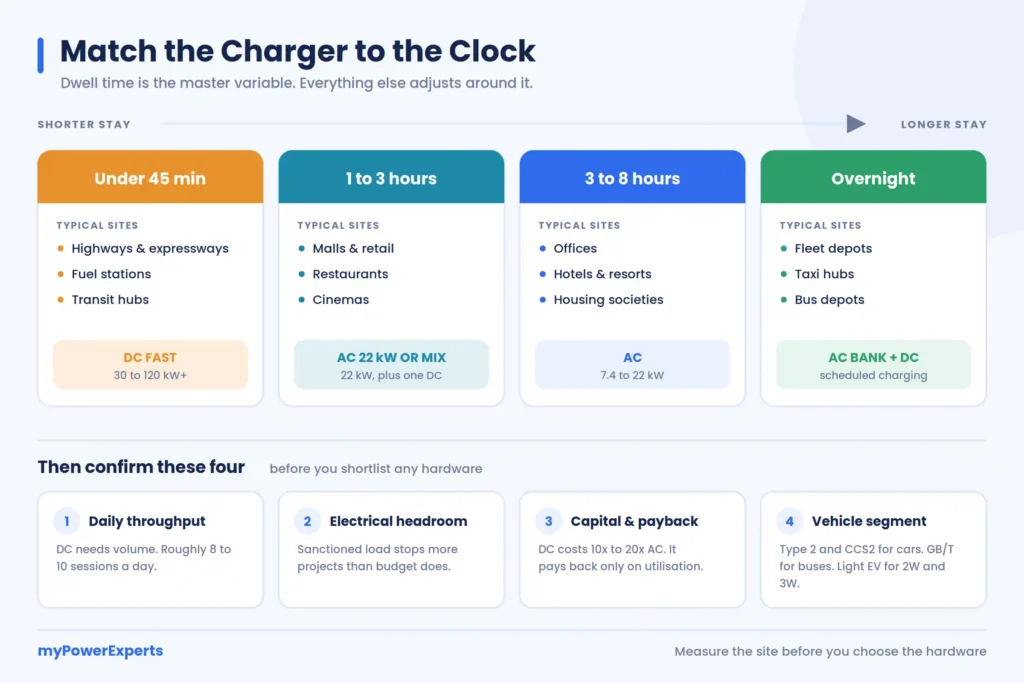
How long vehicles stay is the master variable. Everything else adjusts around it.
| Dwell time | Typical sites | Right choice |
|---|---|---|
| Under 45 minutes | Highways, fuel stations, transit hubs | DC |
| 1 to 3 hours | Malls, restaurants, cinemas | AC 22 kW, or a mix |
| 3 to 8 hours | Offices, hotels, societies, airports | AC |
| Overnight, scheduled | Fleet and bus depots | AC, plus DC for turnaround |
2. Daily vehicle throughput
A DC charger only earns its cost through volume. Break-even for a well-priced DC unit sits near six or seven sessions a day, and economics turn comfortable around eight to ten. Sites seeing two or three sessions stretch payback to four or five years, however attractive the speed sounds.
Count realistic daily sessions before committing, not peak-day optimism.
3. Available electrical capacity
This factor stops more projects than budget does. A 120 kW DC charger needs roughly 130 kW of supply headroom, which many commercial premises simply do not have. Upgrading means a fresh DISCOM application, possibly a transformer, and a timeline measured in weeks or months.
AC chargers often fit inside existing sanctioned load, particularly with load management. Check your sanctioned load and spare headroom before you shortlist any hardware.
4. Capital and payback expectation
DC hardware costs roughly ten to twenty times AC hardware, and site works add more. That investment pays back only at strong utilisation.
AC lets you enter with modest capital and expand as demand proves itself. For businesses treating charging as an amenity rather than a profit centre, AC usually makes the whole case work.
5. Vehicle segment you serve
Cars need Type 2 for AC and CCS2 for DC. Electric buses often use GB/T. Two and three-wheelers use Light EV connectors at much lower power, so installing car-grade DC for a scooter fleet wastes money outright.
Match connectors to the vehicles that will actually arrive. Our guide to CCS2, CHAdeMO and GB/T covers which standard applies where.
What This Means for Your Business Type
Applying those factors to common Indian commercial settings gives clear starting points.
| Business | Recommended setup | Reasoning |
|---|---|---|
| Highway plaza, fuel station | DC primary, one AC | Short stops, high throughput |
| Shopping mall | AC majority, one or two DC | Two to three hour visits, some quick top-ups |
| Hotel, resort | AC only | Overnight stays, guests never rush |
| Office complex | AC only | Full working day parked |
| Housing society | AC only | Overnight charging |
| Restaurant, cafe | One DC, or AC 22 kW | Meal-length stops |
| Fleet or taxi depot | AC bank, plus DC for turnaround | Scheduled overnight, some mid-shift |
| Bus depot | High-power DC, GB/T | Large batteries, tight schedules |
| Public charging hub | DC primary | Revenue depends on throughput |
The Mix Question: How Many of Each
Sites with meaningful traffic rarely want a single type. A blended setup captures both customer patterns while controlling cost.
A workable starting ratio for mixed commercial sites is one DC unit for every three to four AC points. The DC handles drivers who need to leave quickly and generates higher revenue per bay. The AC points serve longer stays at a fraction of the capital cost, which lifts total vehicles served per day without a proportional jump in investment.
Bay allocation matters alongside hardware. DC bays need enforced time limits, since a car left plugged in after reaching 80% blocks your most expensive asset. AC bays can absorb longer occupancy without hurting economics.
Run the Electrical Reality Check First
Before shortlisting any charger, gather four numbers: your sanctioned load, your actual peak demand, your spare headroom, and whether your connection is single or three-phase.
Spare headroom determines what you can install today. Three-phase supply is mandatory for 11 kW and 22 kW AC units and for all DC chargers. Peak demand tells you whether chargers will collide with your existing loads, particularly lifts, pumps, and air conditioning in the evening.
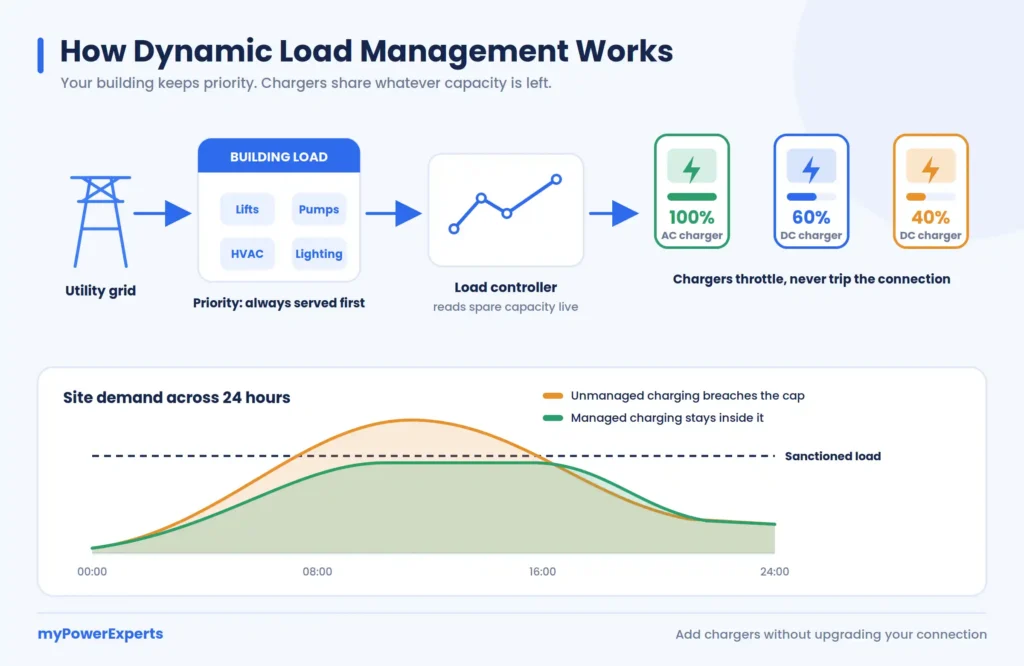
Smart load management changes these limits considerably. Dynamic balancing shares available power across active chargers and throttles them when the building peaks, which often lets a site run several chargers inside existing capacity instead of funding an upgrade.
Commercial tariffs in India carry demand charges based on peak draw, so uncontrolled charging can inflate your bill well beyond the energy consumed. Load management protects that margin directly.
Specifications That Apply to Both
Certain requirements hold regardless of which type you choose.
OCPP support keeps your chargers compatible with any management platform rather than locking you to one vendor, and Ministry of Power guidelines expect public chargers to use open protocols. Our explainer on OCPP and why it matters covers this in depth.
Public chargers also need UPI payment support, and outdoor units need an IP rating of at least IP54, with IP65 preferred for exposed sites.
Domestic manufacturing matters if subsidies are part of your plan, since PM E-DRIVE subsidy release ties to Phased Manufacturing Programme compliance. Our PM E-DRIVE guide explains those conditions and the funding available.
Mistakes That Cost Real Money
1. Buying maximum power regardless of site
A 22 kW AC unit charges a 7.2 kW car at 7.2 kW. The extra capacity sits unused unless you serve many vehicles or higher-spec cars.
2. Ignoring sanctioned load until after purchase
Chargers arrive, then the DISCOM process begins. Months of idle hardware follow.
3. Skipping load management
Demand charges climb, and simultaneous charging trips the connection.
4. Choosing hardware without OCPP
Billing becomes manual, monitoring becomes site visits, and switching platforms means replacing chargers.
5. Planning only for today’s EV count
Adoption at a site accelerates once chargers appear. Size cabling for growth even when installing fewer units initially.
EV Charging ROI Calculator
Estimate monthly revenue and payback for your site
ESTIMATED RESULTS
Conclusion
The right charging setup follows from your site, not from a specification sheet. Measure dwell time and realistic daily throughput, check your electrical headroom honestly, then choose the mix those numbers support.
AC suits long parking and modest capital. DC suits quick turnover and higher traffic. Most commercial sites benefit from both, weighted toward whichever matches how their customers actually behave.
Want help matching chargers to your site? Talk to our team or explore our full AC and DC charger range.
Frequently Asked Questions
1. Should my business install AC or DC chargers?
It depends on dwell time. Choose AC where vehicles park over two hours, such as offices, hotels, and societies. Choose DC where drivers stop briefly, such as highways and fuel stations.
2. How much does a commercial EV charger cost in India?
AC chargers run roughly ₹15,000 to ₹1 lakh depending on power. DC chargers start around ₹4 lakh for 30 kW and reach ₹20 lakh or more for 120 kW, before installation and connection costs.
3. Can I install both AC and DC chargers at one site?
Yes, and mixed setups often work best. A common starting ratio is one DC unit per three to four AC points, provided your sanctioned load supports it.
4. Do I need a three-phase connection for EV chargers?
Yes, for 11 kW and 22 kW AC units and for all DC chargers. Single-phase supply handles 3.3 kW and 7.4 kW AC chargers only.
5. Is a 22 kW AC charger better than a 7.4 kW one?
Only for sites serving many vehicles. Most Indian EVs cap AC charging around 7.2 kW to 11 kW, so a 22 kW unit adds no speed for those cars individually.

Explore Related Articles

Top EV Business Ideas in India 2026
Read Article