PM E-DRIVE Scheme: Government Subsidy for EV Charging Infrastructure
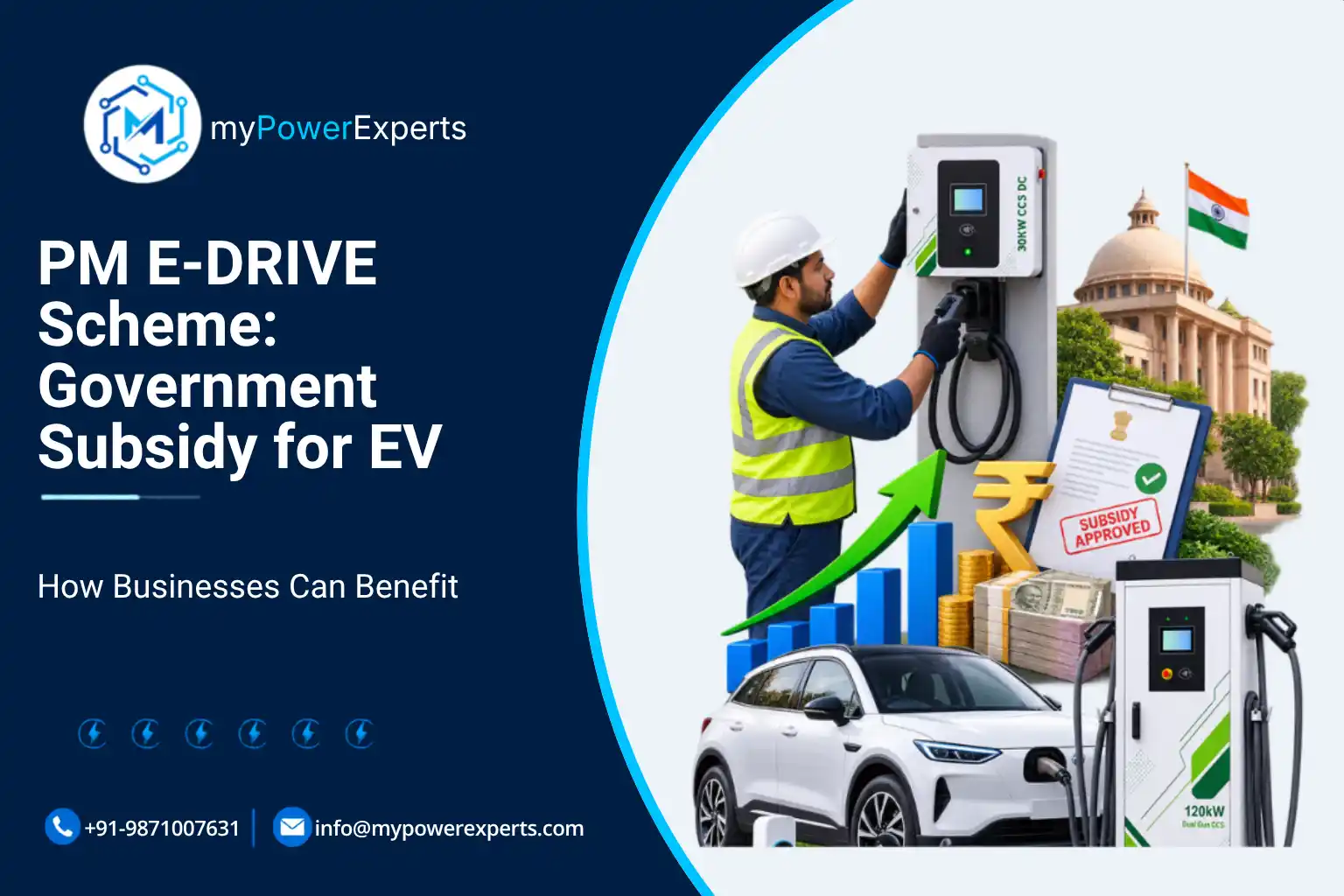
If you plan to set up EV charging stations in India, the PM E-DRIVE scheme is the single biggest funding opportunity available to you right now. The government has set aside ₹2,000 crore purely for charging infrastructure, and in the best cases it covers 100% of your project cost.
This guide covers where PM E-DRIVE actually stands today, who can claim the subsidy, how much you get, and what Indian charging businesses must do to qualify.
What Is the PM E-DRIVE Scheme?
PM E-DRIVE stands for PM Electric Drive Revolution in Innovative Vehicle Enhancement. The Ministry of Heavy Industries launched it on 1 October 2024, and it replaced the earlier FAME II scheme.
The total outlay is ₹10,900 crore. Broadly, the money splits into two jobs. First, demand incentives make EVs cheaper to buy. Second, and more relevant to your business, ₹2,000 crore funds public charging infrastructure across the country.
Originally the scheme was meant to run only until March 2026. Since then, though, the government extended it to 31 March 2028, which matters enormously if you are planning a charging project this year.
Current Status: Where the Scheme Stands in 2026
The overall scheme now runs until 31 March 2028. Meanwhile, demand incentives for electric two-wheelers were extended to 31 July 2026, and the Ministry of Heavy Industries has been considering a further extension as manufacturers push for continued support. Incentives for e-rickshaws and e-carts continue until 31 March 2028. On the other hand, the e-3W (L5) category already closed on 26 December 2025.
Crucially, the charging infrastructure component runs through to 2028. Therefore, the funding window for your charging project is still very much open.
On progress, the numbers tell an honest story. As of May 2026, the government had approved proposals worth ₹503.86 crore covering 4,874 EV chargers. Approved players include CPSEs such as HPCL, IOCL, and BPCL, plus states including Karnataka, Rajasthan, Andhra Pradesh, Uttar Pradesh, Gujarat, Kerala, Telangana, and Tamil Nadu. Karnataka alone secured 1,243 chargers worth ₹123.26 crore.
Now compare that to the target of 72,300 chargers. Clearly, less than 7% of the target has been approved so far. For a charging business, that gap is actually good news, because most of the ₹2,000 crore is still unclaimed.
One caution, though. PM E-DRIVE is a fund-limited scheme. If the money runs out before March 2028, it closes early. So moving quickly genuinely matters.
How Much Subsidy Do You Actually Get?
The subsidy depends entirely on where you install the charger. Specifically, the guidelines split locations into four categories, and each gets a different rate.
| Category | Locations | Upstream Infra | EVSE (Chargers) |
|---|---|---|---|
| A | Government offices, hospitals, schools, colleges, CPSE premises, residential colonies | 100% | 100% |
| B | Railway stations, airports, bus terminals, metro stations, municipal parking, PSU ports, OMC fuel outlets, NHAI toll plazas | 80% | 70% |
| C | Malls, market complexes, city streets, highways and expressways | 80% | Not covered |
| D | Battery swapping and battery charging stations at any location | 80% | Not covered |
Category A carries one important condition. To get that full 100%, the chargers must be open to the public free of charge. In short, the government pays for everything, but the public must be able to use it.
What Counts as “Upstream Infrastructure”
This term confuses a lot of first-time applicants, so let us be specific. Upstream infrastructure covers distribution transformers, low-tension and high-tension cables, AC distribution boxes, circuit breakers, isolators, protection equipment, mounting structures, fencing, and civil work.
EVSE, meanwhile, means the EV supply equipment itself, so the charger and the charging guns.
Notably, the subsidy is calculated on benchmark costs published by the Bureau of Energy Efficiency, or your actual cost, whichever is lower. Additionally, refundable deposits do not count as eligible costs. Consequently, you should budget on benchmark rates rather than assuming your full invoice gets covered.
Who Can Apply?
Private companies cannot apply directly to the Ministry of Heavy Industries. Only these entities can submit proposals: Government of India ministries and departments, Central Public Sector Enterprises, state and union territory governments, and their PSUs.
So how does a private charging business participate? Essentially, you partner. These eligible bodies appoint nodal agencies to aggregate demand, and they then implement projects either directly or by engaging Charge Point Operators. That CPO role is your entry point.
Practically speaking, this means a private CPO wins work through transparent bidding floated by a nodal agency or CPSE. Likewise, if you own suitable land at a good location, you can partner with a CPSE or state agency rather than going it alone.
BHEL serves as the Project Implementation Agency, handling proposal evaluation and support. IFCI acts as the Project Management Agency. All proposals flow through the dedicated PM E-DRIVE portal, which also handles subsidy disbursement and progress reporting.
The Manufacturing Rule That Decides Your Bid
Subsidy release is tied to compliance with the Phased Manufacturing Programme. In other words, the chargers you install must meet domestic manufacturing requirements. When the nodal agency requests the first tranche, it must submit an undertaking certifying PMP compliance.
Therefore, sourcing imported chargers can disqualify your project from subsidy, no matter how attractive the price looks. For any serious bidder, choosing an Indian manufacturer is not a preference. It is a qualification requirement.
On top of that, your hardware must meet the Ministry of Power’s 2024 charging infrastructure guidelines and the relevant IS 17017 standards:
- Two and three-wheelers: Light EV DC (IS 17017-2-6) or Light EV AC/DC Combo (IS 17017-2-7), up to 12 kW
- Cars and buses: CCS2 (IS 17017-2-3), from 50 kW to 250 kW
- Heavy-duty vehicles: CCS2 from 250 kW to 500 kW, delivering at least 120 kW per gun
Furthermore, stations must connect to the National Unified EV Charging Hub for real-time availability and payments. The government is building this out as the Unified Bharat eCharge platform, a UPI-style single interface for locating chargers, booking slots, and paying across networks.
If you are sourcing hardware for a bid, our AC and DC chargers are manufactured in India and built for reliable performance, quality, and long-term durability.
How the Money Actually Reaches You
The subsidy comes in two tranches rather than one lump sum. So plan your cash flow accordingly.
First, the nodal agency submits a proposal with locations, charger counts, vehicle segments, charger capacities, and the subsidy requested. Next, after approval, procurement begins and the CPO gets selected through competitive bidding. Then, once procurement is done and the DISCOM has been paid for the electricity connection, 70% of the subsidy is released against a PMP compliance undertaking. Finally, the balance follows after the station is commissioned and verified.
One practical detail catches many applicants out. Latitude and longitude are optional at the proposal stage, but they become mandatory for both subsidy tranches. So capture accurate site coordinates from day one.
What This Means for Your Charging Business
Let us translate all of this into a commercial strategy, because the subsidy structure quietly favours certain business models.
1. Chase Category A partnerships
A 100% subsidy on both infrastructure and equipment is exceptional. Hospitals, colleges, government offices, and residential societies all qualify. Consequently, approaching these institutions with a ready-to-submit proposal is far easier than pitching a commercial site.
2. Position yourself as a CPO, not an applicant
Since private firms cannot apply directly, your real business development target is the nodal agency or CPSE running the tender. Build those relationships now, while most of the ₹2,000 crore remains unallocated.
3. Watch the 2W and 3W opportunity
Of the 72,300 planned chargers, 48,400 are for two and three-wheelers, compared with 22,100 for cars and 1,800 for e-buses. Yet most operators still chase car charging. That imbalance leaves genuine room in light EV charging.
4. Get your PMP paperwork right early
Because subsidy release depends on domestic manufacturing compliance, your supplier documentation needs to be in order before you bid, not after you win.
For businesses building out networks, our charging solutions for CPOs and fleet operators are designed around exactly these compliance requirements. Alternatively, if you want to launch under your own brand, our white-label OEM programme lets you do that with Make-in-India hardware.
Conclusion
PM E-DRIVE offers Indian charging businesses something rare: up to 100% capital support on a project that generates recurring revenue for years afterwards. The scheme runs until March 2028, roughly ₹1,500 crore of the charging allocation remains unclaimed, and approvals are finally accelerating.
That said, three things decide whether you actually capture it. You need the right partnership route, since private firms bid as CPOs rather than applying directly. You need locations that fit the higher subsidy categories. Above all, you need BIS-certified, PMP-compliant, Indian-manufactured hardware, because that is what unlocks the money.
Get those three right, and the government effectively funds your entry into one of India’s fastest-growing infrastructure markets. Talk to our team to plan the hardware side of your PM E-DRIVE project.
Frequently Asked Questions
1. Who is eligible for subsidy under the PM E-DRIVE scheme?
Government ministries, CPSEs, state and union territory governments, and their PSUs can submit proposals directly. Private companies participate as Charge Point Operators by partnering with these entities or by winning tenders floated by nodal agencies. Individuals with suitable land can also partner with a CPSE or state agency.
2. How much subsidy does PM E-DRIVE give for EV charging stations?
It depends on the location. Government premises, hospitals, schools, and residential colonies with free public access get 100% on both upstream infrastructure and chargers. Airports, railway stations, metro stations, toll plazas, and PSU fuel outlets get 80% on infrastructure and 70% on equipment. Malls, city streets, highways, and battery swapping stations get 80% on infrastructure.
3. Is the PM E-DRIVE scheme still active?
Yes. The government extended the scheme to 31 March 2028.
4. How do I apply for the PM E-DRIVE charging station subsidy?
Proposals go through a nodal agency appointed by your state, union territory, or the relevant central ministry. The nodal agency aggregates demand and submits through the PM E-DRIVE portal, where BHEL evaluates the proposal as Project Implementation Agency. As a private operator, approach your state nodal agency or watch for CPO tenders.
5. What is upstream infrastructure under PM E-DRIVE?
Upstream infrastructure covers everything that brings power to the charger. That includes distribution transformers, high-tension and low-tension cables, AC distribution boxes, circuit breakers, isolators, protection equipment, mounting structures, fencing, and civil work. The charger and guns are classified separately as EVSE.
6. Do chargers need to be made in India to get the subsidy?
Yes, effectively. Subsidy release is linked to Phased Manufacturing Programme compliance, and the nodal agency must certify this when claiming the first tranche. Chargers must also meet Ministry of Power 2024 guidelines and the applicable IS 17017 standards, so BIS-certified Indian-manufactured hardware is the safest route.

Explore Related Articles
EV Charging Stations in India: State-Wise Data and Where the Real Gaps Are
Read Article