
Type 2 EV Charger: Features, Price and Why It is Best for 4-Wheelers
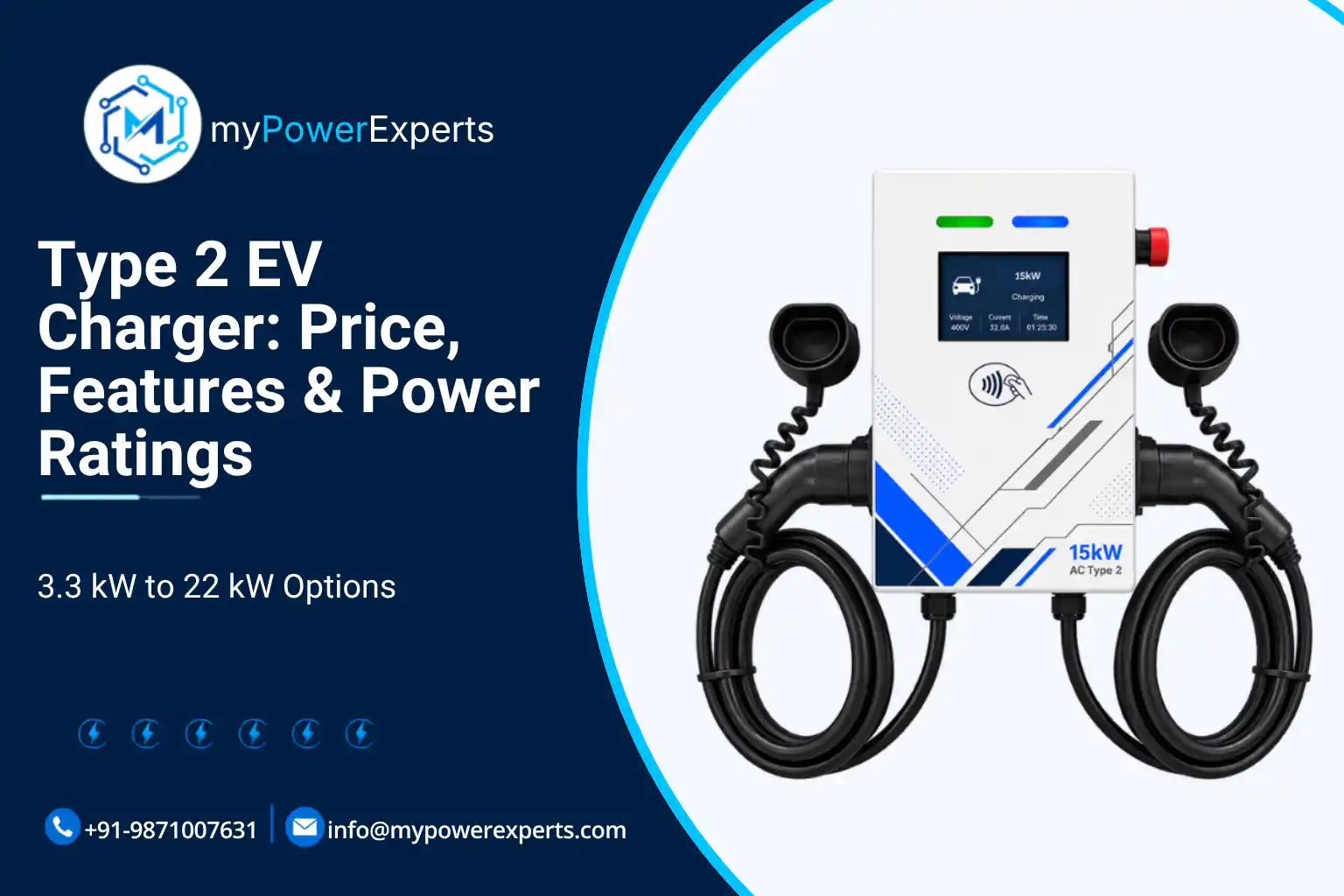
If you drive an electric car in India, or you plan to set up charging for cars, one connector matters more than any other. That connector is Type 2. It is the standard AC charging plug for every modern four-wheeler EV sold in the country, from the Tata Nexon EV to the MG Windsor and Hyundai Creta Electric.
So whether you charge one car at home or plan a bank of chargers for an office, a hotel, or a housing society, understanding Type 2 pays off. In this guide, we cover what a Type 2 charger is, its key features, honest Indian pricing, and why it remains the smartest AC choice for cars.
What Is a Type 2 EV Charger?
A Type 2 EV charger is an AC charging unit that uses the Type 2 connector, a seven-pin plug defined by the international standard IEC 62196. People often call it the Mennekes connector, after the German company that first designed it back in 2009.
The Type 2 plug handles both single-phase and three-phase AC power through the same connector. As a result, one design covers everything from a slow home charger to a fast 22 kW commercial unit. Europe adopted it as the official standard in 2013, and India followed, so today it is the default AC connector across the country.
How Type 2 Charging Actually Works
A Type 2 charger supplies AC power. Your car’s onboard charger then converts that AC into DC to fill the battery.
Your charging speed depends on two things. First, the charger’s power rating. Second, and just as important, your car’s onboard charger limit. So even if you buy a 22 kW charger, your car will only pull what its onboard charger accepts.
Type 2 Charger Power Ratings
Type 2 chargers come in a few standard ratings. Here is how they compare and where each fits best.
| Power | Phase | Best For | Typical Full Charge |
|---|---|---|---|
| 3.3 kW | Single | Basic home, small EVs | 8 to 10 hours |
| 7.4 kW | Single | Homes, offices, hotels | 5 to 7 hours |
| 11 kW | Three | Offices, apartments, fleets | 3 to 5 hours |
| 22 kW | Three | Commercial hubs, malls, workplaces | 2 to 4 hours |
Higher ratings need a three-phase power connection, which most homes do not have but most commercial sites do. Therefore, the right rating depends on your location’s power supply and how long vehicles park there.
For homes, a 7.4 kW single-phase unit hits the sweet spot for most owners. For offices and commercial sites with three-phase power, 11 kW or 22 kW makes better sense because it serves more vehicles per day.
Key Features to Look For
Not all Type 2 chargers are equal. So when you buy, especially for a business, check these features carefully.
1. OCPP support
This open protocol lets your charger connect to any management software. It gives you remote monitoring, usage data, and freedom from vendor lock-in. For commercial use, insist on it. Our explainer on what OCPP is covers why this matters so much.
2. Smart connectivity
WiFi, Bluetooth, or a 4G SIM lets you track sessions, control access, and update firmware remotely. As a result, you manage chargers without visiting each site.
3. RFID and app access
For any shared or public setup, you need to control who charges and bill them. RFID cards and app authentication handle this cleanly.
4. UPI and payment integration
Indian users expect UPI. So a commercial charger should support UPI, cards, and app payment out of the box.
5. IP rating for safety
For outdoor or semi-outdoor use, look for at least IP54, with IP65 preferred. This protects against dust and rain, which extends the charger’s life.
6. Load management
Smart load balancing spreads available power across several chargers. Consequently, you avoid tripping your connection and keep demand charges under control.
7. Safety protections
Good chargers include protection against overcurrent, overvoltage, short circuits, and earth leakage. These are not optional extras. They keep vehicles and people safe.
Type 2 EV Charger Price in India
Type 2 charger prices vary by power, brand, and smart features, yet these ranges reflect the current Indian market.
| Charger | Indicative Price Range |
|---|---|
| 3.3 kW Type 2 | ₹15,000 to ₹30,000 |
| 7.4 kW Type 2 | ₹35,000 to ₹55,000 |
| 11 kW Type 2 | ₹40,000 to ₹70,000 |
| 22 kW Type 2 | ₹75,000 to ₹1,00,000 |
Keep in mind, though, that the charger is only part of the cost. Installation adds more, and the total depends on your existing power supply. If you need a higher sanctioned load or a three-phase connection, your DISCOM will charge extra.
For businesses buying in volume, or for anyone wanting to launch their own charger brand, our Type 2 AC chargers come in 3.3 kW, 7.4 kW, and 22 kW options, all available with OCPP and white-label branding.
Why Type 2 Is the Best Choice for 4-Wheelers
Several reasons make Type 2 the clear AC winner for cars in India.
1. Compatible with Almost Every EV in India
Every modern four-wheeler EV in India uses Type 2 for AC charging. So a Type 2 charger works with all of them, with no compatibility worries.
2. Designed for the Future of EV Charging
Because Type 2 forms the top half of the CCS2 DC connector, the ecosystem is unified. Your car uses one inlet for both home AC charging and public DC fast charging. That consistency is not going away.
3. Ideal for Long Parking Durations
Cars sit parked for hours at homes, offices, and hotels. AC charging fits those windows perfectly, and it does so at a fraction of a DC charger’s cost.
4. Cost-Effective Without Compromising Performance
For sites where vehicles park a while, a Type 2 AC charger delivers plenty of daily range without the heavy investment a DC unit demands. In short, you avoid overspending on speed you do not need.
5. Easy to Expand as Your Charging Network Grows
With OCPP and load management, you can start with a few chargers and grow. Meanwhile, open software keeps you flexible on hardware and platforms.
For a fuller comparison of connector types, our guide on CCS2 vs CHAdeMO vs GB/T explains how Type 2 fits into the wider charging picture.
Type 2 for Business
If you are setting up charging as a business, Type 2 AC deserves a central place in your plan. Here is why it works commercially.
For workplaces and apartments, AC charging matches long parking times, so you serve many vehicles with modest hardware. For hotels and malls, Type 2 chargers add a valued amenity at low cost. For fleet depots, a bank of 11 kW or 22 kW units charges vehicles overnight on a schedule.
Crucially, the economics favour AC where dwell time is long. Rather than installing an expensive DC charger where cars sit for hours anyway, a Type 2 unit does the job for far less. Therefore, a smart site often mixes a few DC chargers for quick turnover with several Type 2 units for longer stays.
If you want to enter this market under your own identity, our white-label OEM programme manufactures Make in India Type 2 chargers in your brand name.
Conclusion
Type 2 EV charger is the backbone of AC charging for cars in India. It is universal, future-proof, affordable, and perfectly matched to how and where Indians park their vehicles. For homes, offices, hotels, societies, and fleets alike, it delivers reliable daily charging without the cost of DC.
The buying rule is simple. Match the power rating to your site’s supply and dwell time, choose smart features like OCPP and UPI for any commercial use, and never pay for more speed than your vehicles can accept. Get that right, and Type 2 gives you dependable charging for years.
Ready to choose the right Type 2 charger for your business or brand? Talk to our team, and we will help you pick the ideal specification.
Frequently Asked Questions
1. What is a Type 2 EV charger?
It is an AC charger using the seven-pin Type 2 (Mennekes) connector under IEC 62196. It is India’s standard AC plug for electric cars and handles single and three-phase power from 3.3 kW to 22 kW.
2. Is Type 2 charging AC or DC?
It is AC. Your car’s onboard charger then converts it to DC for the battery.
3. Which cars use a Type 2 charger in India?
Effectively all modern EVs, including the Tata Nexon EV, MG Windsor, Mahindra BE 6, Hyundai Creta Electric, and BYD models.
4. Is a 22 kW Type 2 charger worth it for my car?
Only if your car accepts it. Most Indian EVs cap AC charging at 7.2 kW or 11 kW, so 22 kW adds no speed for them. It mainly suits commercial sites serving many cars. Check your onboard charger rating first.
5. Can I install a Type 2 charger at home?
Yes. A 7.4 kW single-phase unit fits most homes and charges overnight. For 11 kW or 22 kW you need a three-phase connection from your DISCOM. Always use a qualified electrician.