
Portable EV Charger in India: A Practical Guide for Buyers and EV Brands
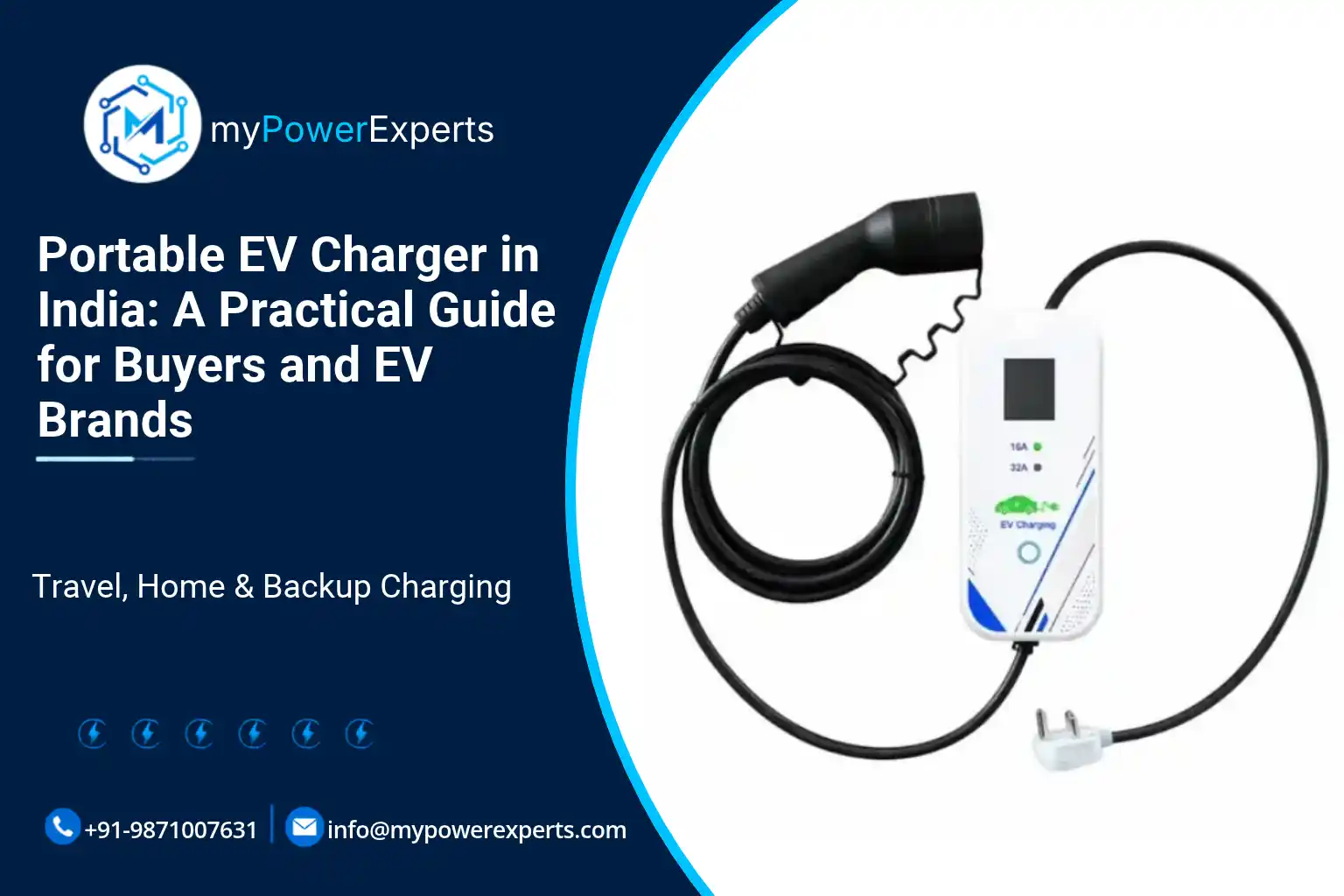
Most EV owners assume a wall charger is the answer until they hit a wall of their own. Renters cannot modify the wiring. Society residents wait months for committee approval. Travellers reach a hometown or hotel with no charger in sight.
A portable EV charger solves that gap. It travels with the vehicle and connects to a suitable electrical supply wherever one exists, without any permanent installation.
Portable units are not simply smaller wall chargers, though. They trade speed for access, and understanding that trade decides whether the product fits your customer.
What a Portable EV Charger Actually Is
A portable EV charger connects an electric vehicle to an AC power source. It stores no electricity itself. Instead, it controls the flow between the socket and the car while handling safety and communication.
A Type 2 portable unit contains a vehicle-side Type 2 connector, a mains plug, a control box holding the charging electronics, current-selection controls on adjustable models, and status indicators.
These are Mode 2 chargers, meaning the protection sits inside the cable assembly rather than in a fixed wallbox. No mounting is needed, but the socket still matters enormously, as we will see.
16A vs 32A Portable EV Charger: Which Capacity Do You Need?
Current rating drives both charging speed and what electrical supply you need.
| Current | AC power | Suits |
|---|---|---|
| 6A to 10A | 1.4 to 2.3 kW | Occasional top-ups, weak circuits |
| 16A | About 3.3 kW | Properly rated 16A socket, overnight charging |
| 32A | About 7.4 kW | Dedicated, properly rated circuit only |
How Fast Does a Portable EV Charger Charge?
| Battery | At 16A (3.3 kW) | At 32A (7.4 kW) |
|---|---|---|
| 25 kWh | 8 to 9 hours | About 4 hours |
| 40 kWh | 13 to 14 hours | About 6 hours |
| 50 kWh | 16 to 17 hours | 7 to 8 hours |
Treat these as approximations. Charging losses, battery temperature, starting charge level, and the vehicle’s own limit all shift the real figure.
Real-World Use Cases for Portable EV Chargers
Five situations account for most real demand.
1. No installation permission
Renters and society residents awaiting approval need charging now, not after paperwork clears. Societies planning permanent infrastructure can explore our residential and commercial charging solutions.
2. Travel and hometown visits
Public charging thins out quickly outside major cities. A portable unit turns any suitable socket into an option.
3. Long parked stays
Hotels, weddings, client sites, and offices often have usable power but no charger. Hours parked become hours charging, where permitted.
4. Second vehicle in the household
One fixed charger plus one portable unit covers two EVs without a second installation.
5. Backup on road trips
Queues and broken public chargers are common. A portable unit removes the single point of failure.
The B2B Opportunity
Beyond individual car owners, portable chargers present a low-risk, high-margin commercial strategy across three key sectors:
1. EV dealerships
Dealerships face a recurring delivery-day problem: customers often collect their new EV while home wallbox installation is still pending, creating an immediate charging gap. A portable unit bridges this gap on day one, adds a lucrative accessory sale, and requires zero site surveys. It also travels with the car, acting as a mobile brand touchpoint.
2. Fleet operators
Fleets use portable units for vehicles finishing shifts away from depots, temporary routes operating ahead of fixed infrastructure, breakdown recovery, and pilot deployments. While they supplement rather than replace depot charging, they offer essential operational flexibility. Larger operations should still standardise on networked hardware using OCPP, and our fleet charging solutions cover depot-scale planning.
3. EV charger brands
Portable units represent the lowest-barrier entry point into the hardware market. Capital per unit is low, logistics are simple since the product ships through standard channels, and no installation network is required to start selling. Selling portable units establishes initial customer trust before expanding into home AC, workplace, and commercial DC fast-charging products.
Launch Your Own Branded Portable EV Charger Range with myPowerExperts
myPowerExperts manufactures EV charging hardware in India on a white-label and OEM basis. Our Type 2 AC portable charger supports Type 2 connectivity, adjustable current settings, charging-status indication, and built-in protections, and it can carry your branding, packaging, and documentation.
Browse the complete range, or talk to our team about supplying portable chargers under your own brand.
Frequently Asked Questions
1. What is a portable EV charger?
A Mode 2 charging device that connects an EV to a suitable AC socket. It carries the control and protection electronics in the cable assembly and needs no permanent installation.
2. Can a portable EV charger be used daily?
Yes, provided the socket and circuit are properly rated for sustained load. Drivers covering high daily mileage usually find a fixed AC charger more practical.
3. Is a 32A portable charger safe on a normal home socket?
No. A 32A unit requires a dedicated, properly rated circuit and compatible socket. Using one on an ordinary household outlet risks overheating.
4. How long does a portable charger take?
At 16A, roughly 8 to 17 hours depending on battery size. At 32A, roughly 4 to 8 hours. Your car’s onboard charger limit may cap it further.
5. Can I sell portable EV chargers under my own brand?
Yes. White-label and OEM manufacturers supply the hardware while you control branding, packaging, and positioning, which makes portable units a low-capital entry into EV charging.