LEVDC Type 6 vs Type 7 (LECCS): Which Standard Should Your Charger Support?
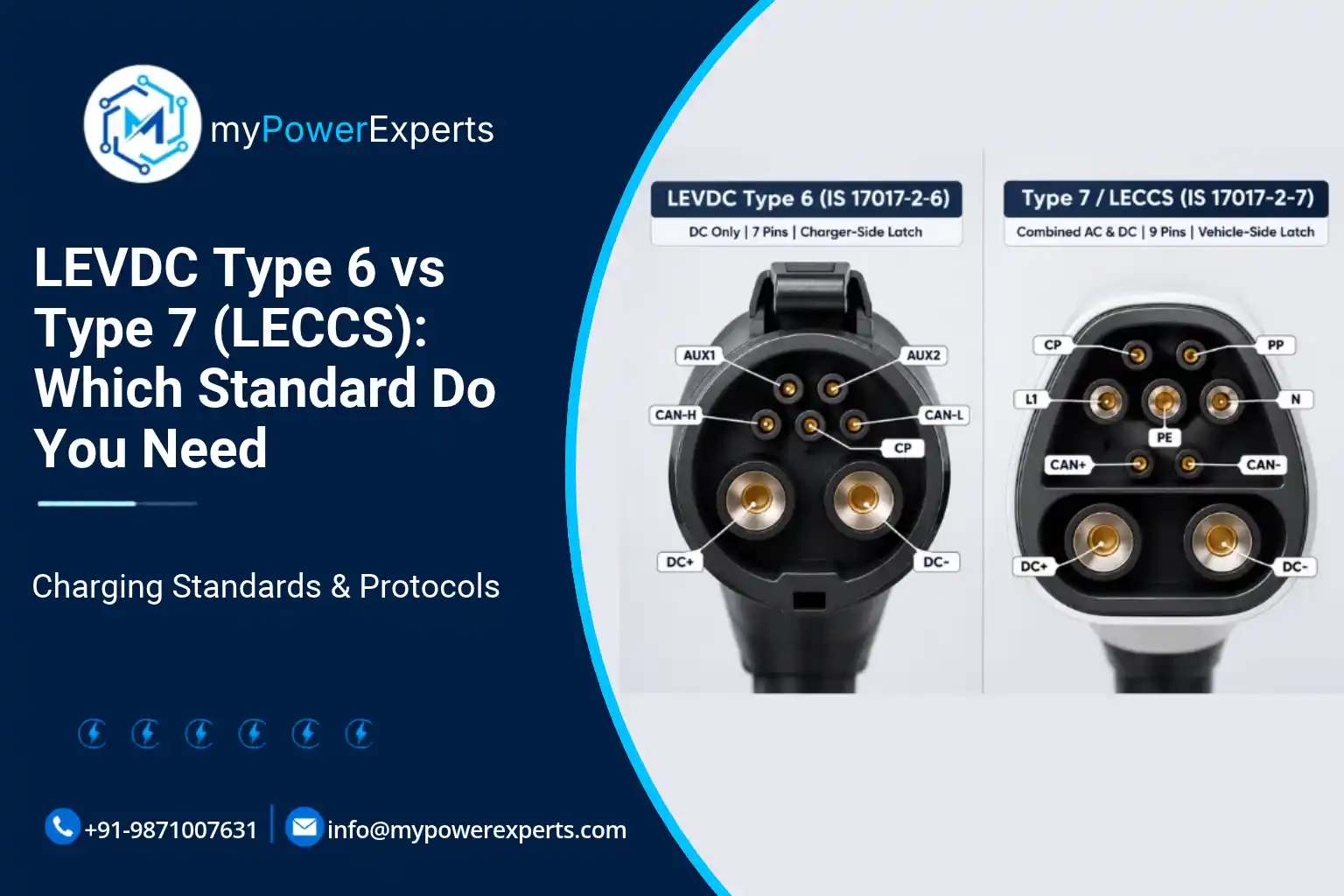
Two and three-wheelers make up most of India’s EV sales. Yet their fast charging is split between two Indian standards. Type 6 is DC only. Type 7, better known as LECCS, handles AC and DC through a single port. Both run at up to 120 V DC. Still, a scooter built for one cannot charge on the other.
For a CPO, fleet operator, or charger brand, that split decides who can use your charger. Pick the wrong connector and a busy site turns away half the vehicles that pull in.
Type 6 vs Type 7 at a Glance
| Feature | Type 6 (LEVDC) | Type 7 (LECCS) |
|---|---|---|
| Indian standard | IS 17017-2-6 (2021) | IS 17017-2-7 (2023) |
| International link | IEC 62196-6 | India-specific |
| Charging type | DC only | Combined AC and DC |
| Maximum DC voltage | 120 V | 120 V |
| DC current | Up to 100 A, extended rating up to 125 A | Up to 100 A |
| DC power | 3 kW to 12 kW | Up to 12 kW |
| AC charging | None | Up to about 7.7 kW (240 V, 32 A) |
| Latch position | Charger side | Vehicle side |
| Communication | CAN bus, as per IS 17017-25 | CAN bus, as per IS 17017-31 |
| Origin | Based on CHAdeMO’s light-EV design | Developed by Ather, open-sourced in 2021 |
| Industry backing | Bharat Charge Alliance (2024) | LEAF consortium led by Hero MotoCorp and Ather (2026) |
Type 6 (LEVDC): The DC-Only Option
Type 6 does one job, which is low-voltage DC fast charging. The charger turns grid AC into DC and feeds the battery directly. So the vehicle needs no large onboard charger for fast sessions.
Its biggest design choice is the latch. Because the lock sits on the charger gun, the vehicle inlet stays simple and cheap. That suits three-wheeler and cargo makers who want to keep vehicle costs down. In addition, the extended 125 A rating gives extra headroom for the larger battery packs in e-3W and light cargo vehicles.
Type 6 succeeded Bharat DC-001, the older GB/T-based standard from the FAME I period. In 2024, a group of makers and operators formed the Bharat Charge Alliance to push it as the common DC standard. Members include Log9, Trinity Cleantech, Tork, Altigreen, ETO Motors, Pulse Energy, and ChargeZone.
Type 7 (LECCS): One Port for AC and DC
LECCS stands for Light Electric Combined Charging System. Ather developed it from 2020, released the design openly in 2021, and BIS approved it in October 2023.
The appeal is simple. A rider uses one port for slow AC charging at home and for DC fast charging on the road. Consequently, the vehicle needs only one inlet, and the rider never thinks about which plug to carry.
The trade-off sits on the vehicle side. LECCS places the latch on the vehicle inlet, so vehicle makers must redesign the inlet, wiring, and charging logic to adopt it. Even so, adoption has moved fast. Ather, Hero Vida, and Matter use it, and so does Bolt. By January 2026, Ather’s grid alone had over 5,000 public fast chargers in 395 cities. Then, in March 2026, Hero MotoCorp, Ather and IPEC launched the LEAF consortium. It has more than 20 members and promotes LECCS as the shared standard.
Key Differences That Matter to a Charger Buyer
1. They are not interchangeable: The pin layout, latch, and communication protocol all differ. So a Type 6 vehicle cannot charge from a Type 7 gun, and no simple adapter fixes that.
2. Two guns are not enough: Type 6 talks to the vehicle under IS 17017-25, while LECCS uses IS 17017-31. A charger that truly supports both needs firmware for both protocols, not just two different cables.
3. AC capability changes the site plan: LECCS vehicles can also charge on AC, which lets a site mix low-cost AC points with a few DC units. Type 6 vehicles, on the other hand, need DC hardware for every fast session.
4. Current headroom suits heavier vehicles: Type 6’s extended 125 A rating helps three-wheelers and cargo vehicles with bigger packs. Meanwhile, most scooters never need more than 100 A, so LECCS covers them comfortably.
5. Vehicle cost sits in different places: Type 6 keeps the vehicle inlet cheap and puts the latch on your charger. LECCS adds cost to the vehicle but gives riders a single port.
Which Vehicles Use Each Standard?
| Segment | Common standard | Examples |
|---|---|---|
| Premium and mass-market scooters | Type 7 (LECCS) | Ather 450 and Rizta, Hero Vida, Matter |
| Electric motorcycles | Mixed | Tork uses Type 6; check each model |
| E-3W passenger and cargo | Mostly Type 6 | Altigreen, ETO Motors, Surja |
| Battery and fleet platforms | Type 6 | Log9-powered fleets |
| Brands with their own networks | Proprietary or mixed | Ola, TVS and Bajaj rely largely on their own hardware |
Which Standard Should Your Charger Support?
Public CPO in a city: support both. Scooters dominate urban traffic, and most new scooters charge on LECCS. However, three-wheelers and delivery vehicles often arrive on Type 6. A dual-standard charger keeps every driver a customer.
Scooter-heavy locations such as malls, metro parking, and campuses: lead with Type 7. Add a Type 6 gun if delivery riders or e-3W drivers use the site.
E-rickshaw and cargo depots: match the fleet. If your vehicles carry Type 6 inlets, Type 6 chargers are simpler and cost less. For a mixed fleet, choose dual-standard units.
Captive single-brand fleets: buy exactly what your vehicles use. A second connector nobody plugs in adds cost and nothing else.
Charger brands and white label buyers: offer both. Your customers will ask for each, and a catalogue with only one standard loses half the enquiries.
Checklist Before You Order
- Confirm the inlet type on every vehicle model you expect to serve
- Check that vehicle battery voltages sit within the charger’s DC output range
- Ask whether a dual-standard charger runs both IS 17017-25 and IS 17017-31 protocols
- Insist on OCPP 1.6J or later, so any charging software can manage the unit
- Plan the supply: 3 kW and 6 kW units usually run on single-phase, while 12 kW units usually need three-phase
- Decide between single-gun and dual-gun LEVDC chargers based on how many vehicles queue at peak hours
Will India Settle on One Standard?
Not yet. Both are published BIS standards, so for now the market decides, not a mandate. Type 6 has strong support among three-wheeler makers and fleet-focused operators. LECCS, meanwhile, has the larger scooter base and the faster-growing public network.
LEVDC Chargers Built for Both Standards
myPowerExperts manufactures LEVDC fast chargers in India at 3 kW, 6 kW, and 12 kW, with Type 6, Type 7, or both connectors. Single and dual-gun options are available, and in dual-gun units, both guns charge at the same time. Every unit is OCPP-ready, so it works with your choice of charging software.
For most public sites and mixed fleets, dual-standard chargers remove the guesswork. Talk to our team to choose the right LEVDC setup for your vehicles.
Frequently Asked Questions
1. What is LECCS charging?
LECCS stands for Light Electric Combined Charging System, India’s Type 7 standard (IS 17017-2-7). It lets two and three-wheelers charge on AC and DC through one port.
2. Can a Type 6 vehicle charge on a Type 7 charger?
No. The pins, latch, and communication protocol differ, so the two are not interchangeable.
3. Which connector do Ather and Hero Vida scooters use?
Both use Type 7 (LECCS). Ather developed the standard, and Hero MotoCorp adopted it.
4. Which standard is better for e-rickshaws and e-3W fleets?
Most e-3W and cargo makers use Type 6, which suits DC-only depot charging.
5. Can one charger support both Type 6 and Type 7?
Yes. Dual-standard LEVDC chargers carry both connectors and run both communication protocols, so a single unit can serve scooters and three-wheelers at the same site.
6. Is LECCS used for electric cars?
No. LECCS and Type 6 cover light EVs up to 120 V DC. Electric cars in India use CCS2 for DC fast charging and Type 2 for AC.

Explore Related Articles
Dual Gun LEVDC Chargers: Double Your Light EV Charging Throughput
Read Article