
3-Output EV Charger for Electric 2-Wheeler and 3-Wheeler Fleets
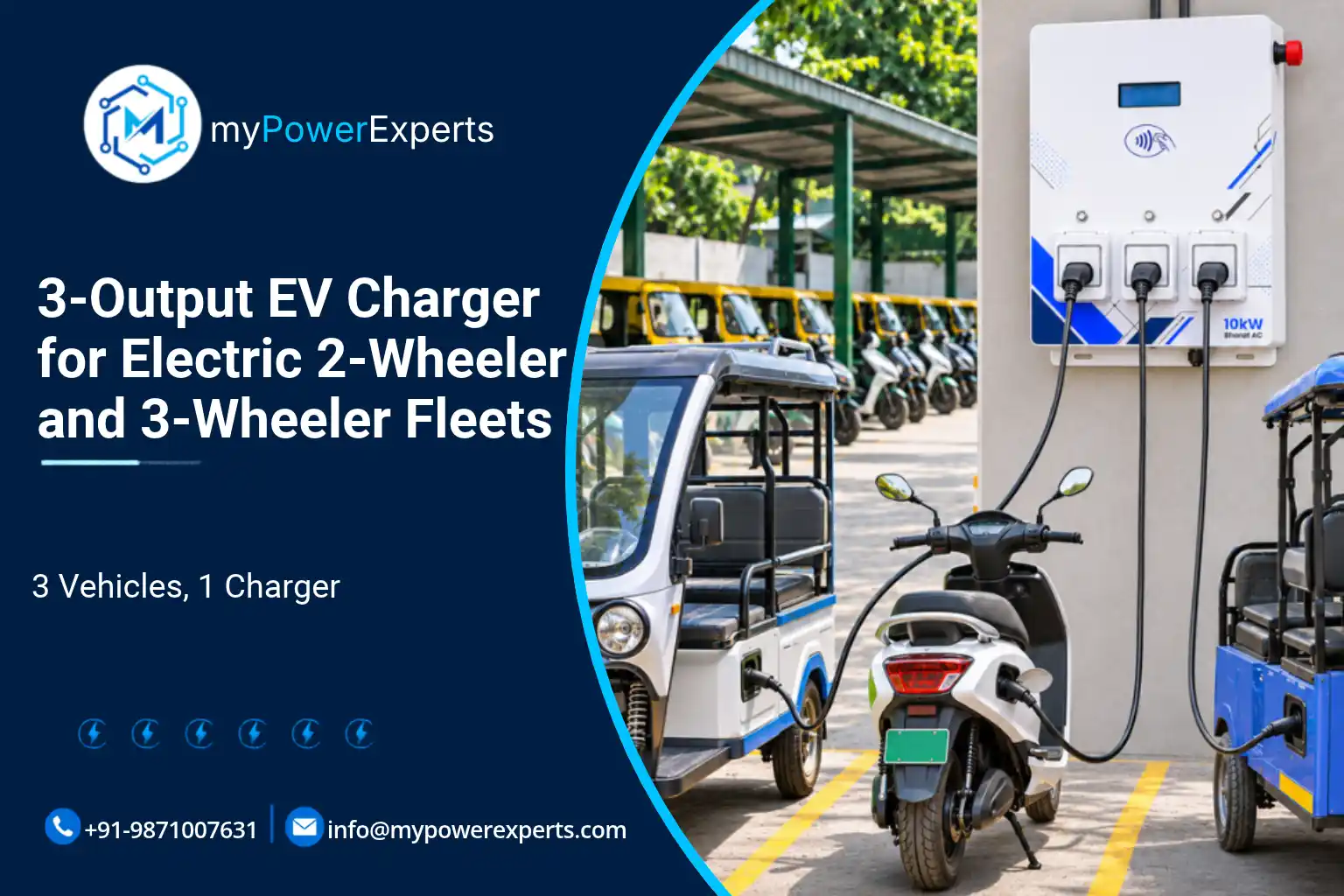
Electric scooters, delivery bikes and e-rickshaws now make up most of India’s EV fleet, and most of them still charge from an ordinary wall socket. That works for one rider at home. At a depot charging thirty vehicles every night, however, it becomes a safety and management problem.
A 3-output OCPP charger solves both. One unit charges three vehicles at once, protects every session, and reports each one to your software.
What Is a 3-Output EV Charger?
A 3-output charger is an AC charging station with a three-phase input and three single-phase outputs of 3.3 kW each. In effect, it splits one three-phase supply into three protected, individually controlled charging points.
| Specification | Detail |
|---|---|
| Input | Three-phase AC |
| Outputs | 3 single-phase outputs |
| Power per output | 3.3 kW |
| Vehicles charged at once | 3 |
| Socket per output | 16A 3-pin, fits OEM cables directly |
| Software | OCPP, connected to a Charging Management System |
| Control and billing | Mobile app, part of the CMS |
The design follows the same idea as India’s Bharat AC-001 standard, which also uses a three-phase input and three 3.3 kW outputs for two and three-wheelers.
How It Works
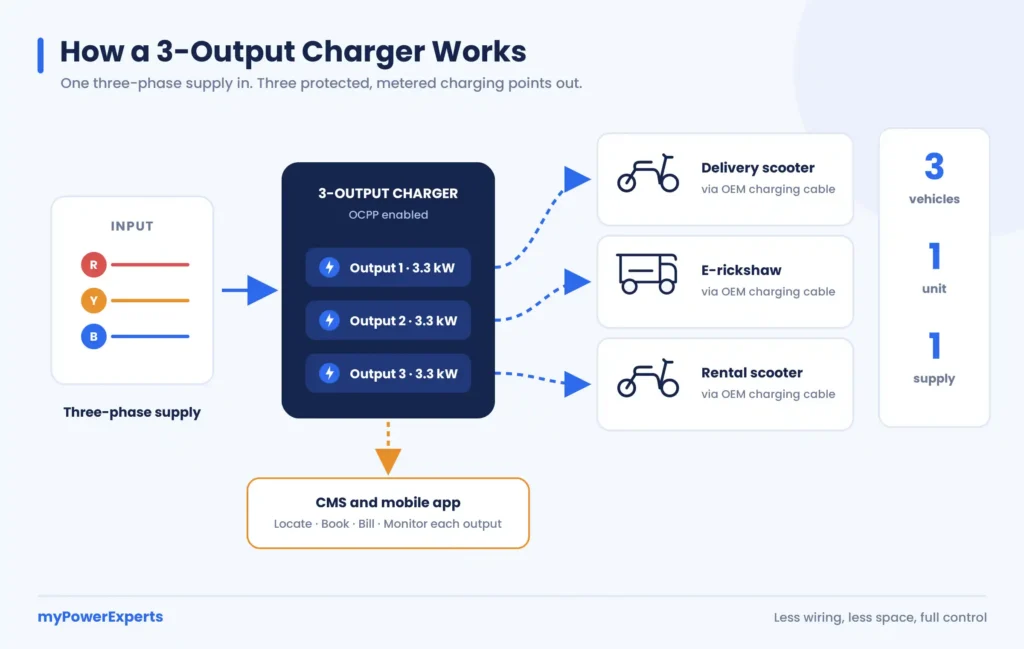
Each output carries a 16A 3-pin socket, so the rider plugs the vehicle maker’s charging cable straight into any of the three outputs, with no adapter needed. The vehicle’s own charger then handles the battery, while the station supplies power, protection and data.
Each output also runs as a separate charge point inside your CMS. As a result, you can start or stop any session from the app, see live consumption and bill each vehicle on its own.
One practical point matters here. Most two-wheeler and e-rickshaw chargers draw well under 3.3 kW, so the vehicle’s charger, not the station, usually sets the charging time. The 3.3 kW rating simply gives every output enough headroom for any common 2W or 3W charger.
Why Not Just Use a Plain Wall Socket?
A plain wall socket can charge a scooter. However, it has no way to stop a fault, no meter for each vehicle, and no link to your software. For a fleet, those gaps cost money and create risk.
The socket on each output looks familiar, but the station behind it adds four protections and controls.
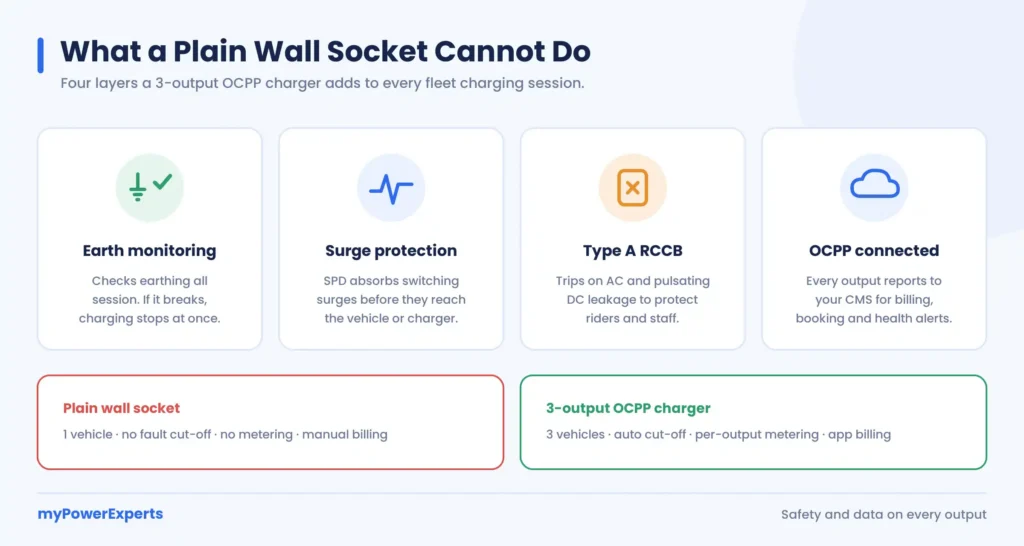
Continuous earth monitoring: The charger checks the earth connection throughout the session. If earthing breaks at any point, charging stops at once. A wall socket keeps supplying power with a broken earth, which is exactly when a fault becomes dangerous.
Surge Protection Device (SPD): Switching surges can occur while many chargers run together. The SPD absorbs them before they reach the vehicle electronics or the station.
Type A RCCB: This device trips on AC leakage current and pulsating DC leakage, protecting riders and staff from shock.
OCPP compliance: The charger connects to any OCPP-based CMS or mobile app for locating, booking, billing, and monitoring. Our OCPP guide explains why this matters for long-term flexibility.
| Feature | Plain Wall Socket | 3-Output OCPP Charger |
|---|---|---|
| Vehicles per point | 1 | 3 |
| Earth fault cut-off | No | Yes |
| Surge protection | Rarely | Built in |
| Leakage protection | Depends on wiring | Type A RCCB |
| Per-vehicle metering | No | Yes |
| Remote start and stop | No | Yes |
| Billing | Manual | Automatic through CMS |
| Charger health alerts | No | Yes |
When a fleet needs faster turnaround than overnight AC charging allows, LEVDC chargers with Type 6 and Type 7 connectors deliver DC straight to the battery. Our DC fast charger range covers these for 2W and 3W vehicles.
Why Fleet Operators Need It
Space: One compact unit replaces three wall sockets and three runs of wiring. In tight depots and parking lots, that frees room for more vehicles.
Safety at scale: Thirty vehicles charging overnight on unprotected sockets is a real fire and shock risk. Protection on every output lowers that risk sharply, often with no staff on site.
Monitoring: The CMS shows which outputs are busy, which vehicles are done, and which unit needs attention. Consequently, a fault gets fixed before the morning shift, not after riders arrive to flat batteries.
Billing: Many fleets now charge riders, franchisees, or gig partners for energy. Per-output metering through the app makes that billing exact and automatic.
Balanced load: Three single-phase outputs on one three-phase input spread demand across the supply instead of overloading a single phase.
How Many Chargers Does Your Fleet Need?
Start with your fleet size and charging window. Most 2W and 3W fleets charge overnight, so every vehicle needs one output for the night.
| Fleet size | 3-Output chargers | Maximum connected load |
|---|---|---|
| 15 vehicles | 5 | About 50 kW |
| 30 vehicles | 10 | About 99 kW |
| 60 vehicles | 20 | About 198 kW |
These are worst-case figures. Since most vehicle chargers draw far below 3.3 kW, the real load usually sits well under the maximum. Even so, check your sanctioned load with your DISCOM before ordering, and add load management for larger depots.
If you run shift-based operations with mid-day top-ups, add a few DC units for quick turnaround while 3-output chargers handle the overnight bulk.
Who Should Use a 3-Output Charger?
This charger suits any site where many light EVs park for hours:
- Delivery and logistics fleets using e-scooters
- E-rickshaw and L5 three-wheeler operators
- Bike rental and bike taxi companies
- Battery-swap partners and charging hubs
- Housing societies and offices with many two-wheelers
- CPOs building low-cost 2W and 3W charging points
For larger rollouts, our fleet charging solutions cover depot planning, while our CPO solutions suit operators building public networks.
Conclusion
For a single rider, a wall socket is fine. For a fleet, though, it leaves you with no fault protection, no data, and no billing. A 3-output OCPP charger charges three vehicles from one compact unit, cuts power the moment earthing fails, guards against surges and leakage, and puts every session on your dashboard.
myPowerExperts manufactures 3-output and other AC EV chargers in India, with OCPP built in and white label options for businesses selling under their own brand.
Talk to our team about the right setup for your fleet.
Frequently Asked Questions
1. What is a 3-output EV charger?
An AC charger with a three-phase input and three 3.3 kW single-phase outputs. It charges three electric two-wheelers or three-wheelers at the same time from one unit.
2. Can I use the vehicle’s own charger with it?
Yes. Each output has a 16A 3-pin socket, so the OEM cable plugs in directly. The vehicle’s charger manages the battery, while the station adds protection, metering, and OCPP control.
3. What does OCPP do for a fleet charger?
OCPP links the charger to a management system or app. Operators can monitor charger health, start or stop sessions remotely, and bill each vehicle automatically.

Explore Related Articles
Type 2 EV Charger: Features, Price and Why It is Best for 4-Wheelers
Read Article