What is OCPP and Why Every EV Charging Business Needs It
Buy the wrong EV charger today, and you could lose control of your entire charging network tomorrow. That sounds dramatic, yet it happens regularly across India. Operators purchase cheap chargers, discover the software only talks to one vendor, and then find themselves stuck paying whatever that vendor demands.
Open Charge Point Protocol (OCPP) exists to prevent exactly this. In simple terms, it is the common language that lets any charger talk to any management software. Moreover, Indian regulations now expect it, and government-funded projects effectively require it.
So let us break down what OCPP actually does, which version your business should choose, and how to avoid the procurement trap that catches most first-time buyers.
What Is OCPP?
OCPP stands for Open Charge Point Protocol. Essentially, it is a free and open communication standard that connects your charging stations to your charging management system, which the industry calls a CSMS or CMS.
The Open Charge Alliance maintains it. This group formed in 2013 and now includes charging companies, utilities, and software providers from around the world. Importantly, nobody owns OCPP commercially, so no single vendor can lock you in.
How OCPP Works in Practice
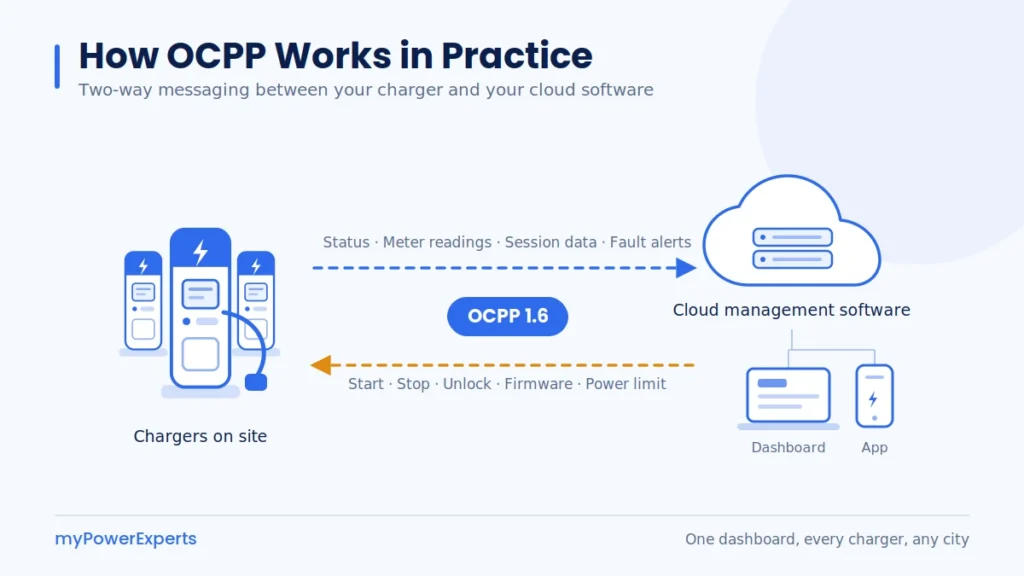
Your charger sits at a site somewhere. Meanwhile, your management software runs in the cloud. OCPP carries messages between the two, in both directions, over the internet.
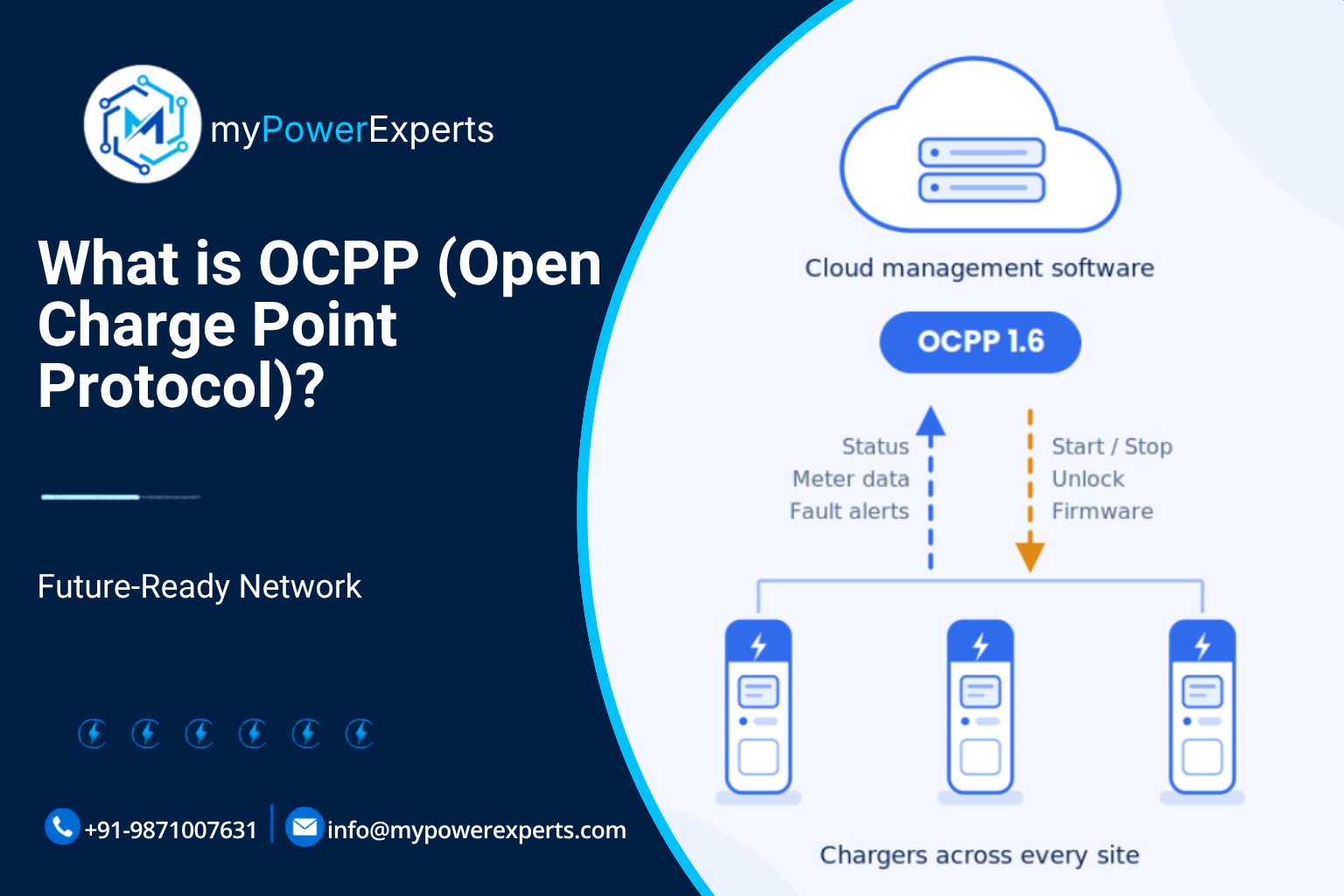
From the charger to your software, OCPP sends live status updates, meter readings, session data, and fault alerts. From your software to the charger, it sends commands: start a session, stop a session, unlock the connector, push a firmware update, or reduce power draw.
As a result, you can manage a hundred chargers across five cities from one dashboard. Without OCPP, you would need someone physically present at each site.
The Protocol Stack: Where OCPP Fits
Here is where many buyers get confused, so let us clear it up properly. OCPP is not the only protocol in a charging network. In fact, four layers work together, and each handles a different conversation.
| Protocol | Connects | What It Handles |
|---|---|---|
| ISO 15118 | Vehicle to charger | Plug and Charge, bidirectional charging |
| OCPP | Charger to management software | Remote control, monitoring, billing data |
| OCPI | Your network to other networks | Roaming, so other operators’ users can charge with you |
| OpenADR / UEI | Management software to DISCOM | Demand response, grid signals |
OCPP Versions: 1.6, 2.0.1 and 2.1
Three versions matter commercially right now.
| Feature | OCPP 1.6 | OCPP 2.0.1 | OCPP 2.1 |
|---|---|---|---|
| Released | 2015 | 2020 | January 2025 |
| Status in India | Still common | Preferred baseline | Emerging |
| Security | Basic, TLS only | Three security profiles, certificates | Same as 2.0.1 |
| Device management | Limited | Full remote configuration | Full remote configuration |
| Smart charging | Basic load balancing | Advanced | Further improved |
| ISO 15118 support | No | Yes (15118-2) | Yes (15118-20) |
| Bidirectional (V2X) | No | No | Yes |
| Backward compatible | n/a | Not with 1.6 | Yes, with 2.0.1 |
A few practical notes follow from that table.
OCPP 1.6 comes in two flavours
You will see tenders specify “1.6J” rather than just 1.6. The J means JSON over WebSockets, while S means SOAP. Always choose 1.6J, because SOAP is effectively obsolete.
1.6 and 2.0.1 are not compatible
They use different application logic entirely. So upgrading means firmware changes on the charger and backend changes on your software, not a simple settings toggle.
2.0.1 became an international standard
The IEC approved it as IEC 63584 in 2024, which gives it real weight in tenders and procurement documents.
2.1 builds on 2.0.1 rather than replacing it
It adds bidirectional charging, distributed energy resource control, better smart charging, and more payment options, including QR codes and cards. Crucially, application logic written for 2.0.1 continues to work.
For most Indian operators buying today, OCPP 2.0.1 is the sensible baseline, with 2.1 readiness as a bonus.
Why Every EV Charging Business Needs OCPP
Here are the reasons that actually affect your profit and loss.
1. You avoid vendor lock-in
With a proprietary charger, the manufacturer controls your software, your pricing, and your data. If they raise fees or go out of business, you have very little recourse. With OCPP, you simply move your chargers to a different platform.
2. You cut service costs dramatically
Remote diagnostics let your team identify faults, restart chargers, and push firmware updates without dispatching an engineer. Given India’s distances, one avoided site visit can cover months of software fees.
3. You protect uptime, which protects revenue
A charger that sits faulted for three days earns nothing. However, OCPP alerts tell you the moment something breaks, so you fix it before customers notice.
4. You manage electricity demand charges
Smart charging lets you cap total site load and balance power across connectors. For commercial sites in India, where demand charges hit hard, this single feature often justifies the investment.
5. You unlock roaming and higher utilisation
Once your network speaks open protocols, you can join roaming hubs through OCPI. Consequently, drivers from other networks can charge at your stations, which lifts utilisation on otherwise quiet sites.
6. You keep resale and exit value
Open hardware transfers cleanly to a buyer or partner. Proprietary hardware, on the other hand, carries a discount because the buyer inherits the lock-in.
Choosing an OCPP EV Charger in India
1. Choose an OCPP-compliant EV Charger only.
2. Target OCPP 1.6J upgradable to 2.1, in the future.
3. Check the connector standards match Indian norms under IS 17017, so Type 2 and CCS2 for cars, and Light EV DC or AC/DC Combo for two and three-wheelers.
4. Confirm domestic manufacturing if you plan to bid for PM E-DRIVE projects, because subsidy release ties to Phased Manufacturing Programme compliance.
For operators building networks, our charging solutions for CPOs are designed around these requirements. Sell chargers under your own brand, our white-label OEM supplies Make-in-India hardware with open protocol support built in.
Conclusion
Open Charge Point Protocol is the difference between owning a charging network and merely renting one. It keeps your hardware and software independent, cuts your operating costs, and satisfies the open protocol expectations written into Indian regulation and government tenders.
The strategy is straightforward. Choose OCPP 2.0.1 as your minimum, demand OCA certification rather than marketing claims, pair OCPP with OCPI once you want roaming, and test everything against your management platform before scaling. Do that, and your network stays flexible for years instead of locking you into decisions you made on day one.
Ready to specify the right hardware for your project? Talk to our team, and we will walk you through the protocol and compliance requirements for your specific use case.
Frequently Asked Questions
1. What is OCPP in EV charging?
OCPP, or Open Charge Point Protocol, is an open communication standard that connects EV chargers to charging management software. It lets operators monitor stations, start and stop sessions, update firmware, set tariffs, and control power remotely.
2. Is OCPP mandatory in India?
For public charging, effectively yes. The Ministry of Power’s 2024 guidelines direct public charging operators to adopt open protocols including OCPP and OCPI, alongside UPI payments.
3. What is the difference between OCPP 1.6 and 2.0.1?
OCPP 2.0.1 adds proper security with certificate-based profiles, full remote device management, advanced smart charging, better transaction handling, and ISO 15118 support. OCPP 1.6 offers only basic functions and TLS-level security.
4. What is the latest version of OCPP?
OCPP 2.1 is the latest version, released in January 2025, with Edition 2 following in late 2025.
5. What is the difference between OCPP and OCPI?
OCPP connects your chargers to your own management software. OCPI connects your network to other operators’ networks so their customers can charge at your stations and vice versa.
6. How do I know if a charger is really OCPP compliant?
Ask for Open Charge Alliance certification rather than accepting a datasheet claim. The OCA runs a formal certification programme and publishes certified products in a public register.

Explore Related Articles