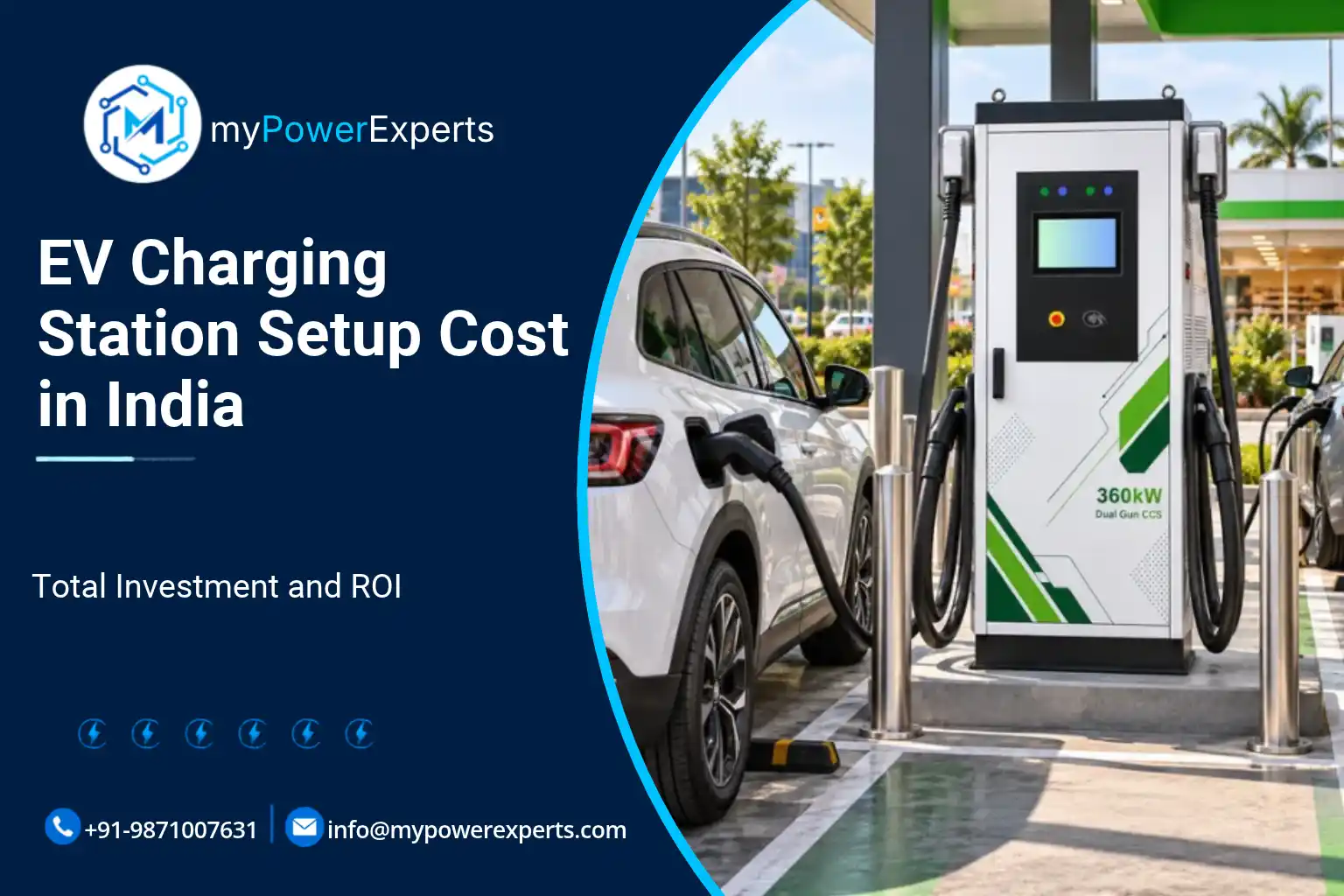
EV Charging Station Setup Cost in India: Total Investment and ROI
Ask a supplier what a 60 kW DC charger costs and you will get a number. That number is rarely more than half of what your station actually costs to build.
Equipment typically accounts for only 30 to 50 percent of total investment in a commercial charging station. The rest disappears into DISCOM connections, transformers, cabling, civil work, software, and approvals, and first-time operators routinely discover this after committing their budget.
This guide breaks down the full cost stack, the monthly running costs most guides skip, and three worked payback scenarios using realistic Indian numbers.
What Actually Goes Into the Capex
Every commercial station carries seven cost heads.
| Component | Indicative cost | Notes |
|---|---|---|
| Chargers | ₹35,000 to ₹20 lakh | AC from ₹35,000; DC from ₹4 lakh |
| DISCOM connection | ₹50,000 to ₹3 lakh | Security deposit plus load sanction |
| Transformer | ₹2 lakh to ₹5 lakh | Needed when load exceeds local threshold |
| Cabling and electricals | ₹1 lakh to ₹4 lakh | LT panel, protection, earthing, trenching |
| Civil work | ₹1 lakh to ₹3 lakh | Foundation, flooring, canopy, bollards, signage |
| Software and integration | ₹20,000 to ₹1 lakh | CMS onboarding, OCPP setup, payment gateway |
| Approvals and testing | ₹25,000 to ₹1 lakh | CEIG clearance, fire NOC, commissioning |
Transformer requirement is the single biggest swing factor. Sites with spare sanctioned load skip a ₹2 lakh to ₹5 lakh line item entirely, which is why the same charger produces wildly different project costs at two locations.
Total Investment by Station Type
| Station type | Typical total |
|---|---|
| 2 AC chargers (7.4 kW) at an office or society | ₹2.5 lakh to ₹4 lakh |
| 1 AC plus 1 DC (30 kW) at a commercial site | ₹11 lakh to ₹15 lakh |
| 1 DC (60 kW) plus 2 AC at a highway or hub site | ₹20 lakh to ₹30 lakh |
| Multi-charger hub with 100 kW plus capacity | ₹35 lakh to ₹50 lakh and above |
Adding DC capacity to an existing AC site later costs substantially less than building DC standalone, because the connection, trenching and civil base already exist. That single fact shapes the phasing strategy covered in our guide on choosing AC and DC chargers.
The Running Costs Nobody Quotes
Monthly opex determines whether a station makes money, yet most cost guides stop at capex.
| Cost head | Typical monthly |
|---|---|
| Electricity | Largest variable, tied to units sold |
| Site rent or revenue share | ₹5,000 to ₹25,000 |
| CMS subscription | ₹500 to ₹1,000 per charger |
| Maintenance and AMC | ₹2,000 to ₹5,000 |
| Payment gateway | Roughly 1 to 2 percent of revenue |
| Connectivity and insurance | ₹1,000 to ₹3,000 |
Electricity cost depends heavily on your state, and the gap is large. Karnataka’s BESCOM lists ₹4.50 per unit for LT and HT EV charging stations. Maharashtra offers a concessional EV tariff around ₹5 to ₹5.50 per kWh, with demand charges waived for commercial stations in the early policy years. Delhi, Gujarat, Kerala, Tamil Nadu, Telangana and Uttar Pradesh all maintain dedicated EV tariff categories.
Apply for the EV tariff rather than running on a standard commercial connection. Demand charges deserve equal attention, since they are billed on your peak draw rather than your consumption, and an uncontrolled DC charger can inflate them badly. Load management directly protects this line.
Where the Revenue Comes From
Public DC charging in India retails at roughly ₹18 to ₹25 per kWh. Public AC sits around ₹8 to ₹18. Against an EV tariff of ₹4.50 to ₹9, gross margin lands near ₹10 to ₹15 per unit on DC and ₹4 to ₹6 on AC.
Two numbers then decide everything: margin per unit and units sold per day. Margin is largely set by your state tariff and local pricing. Units sold is set by location, which is why site selection outranks hardware selection in importance.
Three Worked ROI Scenarios
Assumptions used throughout: DC retails at ₹20 per unit against a landed electricity cost of ₹8 to ₹9 (giving an ₹11 to ₹12 margin). AC retails at ₹12 against ₹7, giving a ₹5 margin. Opex is deducted before payback.
Scenario A: Office or society, 2 AC chargers
Capex ₹3 lakh. Around 83 units sold daily at ₹5 margin gives ₹12,450 monthly. After ₹4,000 opex, net is ₹8,450.
Payback: about 36 months.
Scenario B: Commercial site, one 30 kW DC charger
Capex ₹12 lakh. Eight sessions daily averaging 18 units gives 144 units at ₹12 margin, or ₹51,840 monthly. After ₹15,000 opex, net is ₹36,840.
Payback: about 33 months.
Scenario C: Highway site, one 60 kW DC charger
Capex ₹15 lakh. Eighteen sessions daily averaging 15 units yields 270 units at an 11 margin (₹20 retail vs ₹9 energy cost), giving ₹89,100 monthly. After ₹30,000 opex, net is ₹59,100.
Payback: comfortably under 3 years.
What Actually Destroys ROI
1. Low utilisation
Break-even for a DC unit sits near six or seven sessions a day. At two or three, payback stretches to four or five years. Location decides this before you buy anything.
2. Overbuilding power
A 120 kW charger at a site averaging four sessions daily earns the same as a 30 kW unit costing a third as much. Match power to dwell time and traffic.
3. Ignoring demand charges
Peak-based billing can quietly consume a large share of margin at sites without load management.
4. Downtime
A faulted charger earns nothing. Remote diagnostics through OCPP turn multi-day outages into same-day fixes and remove most site visits.
5. Budgeting only for hardware
The 30 to 50 percent rule means a ₹5 lakh charger quote implies a ₹10 lakh to ₹16 lakh project. Plan for the whole stack.
How Subsidy Changes the Maths
PM E-DRIVE covers up to 100 percent of both upstream infrastructure and equipment at qualifying locations such as government premises, hospitals, schools and residential colonies, and 80 percent on infrastructure with 70 percent on equipment at airports, railway stations, metro stations, toll plazas and PSU fuel outlets.
Applying 70 percent support to Scenario B drops effective capex from ₹12 lakh to around ₹3.6 lakh, which cuts payback from 33 months to under 12. Several states add their own support, including a 25 percent capital subsidy on charging equipment in Karnataka and viability gap funding in Maharashtra.
Subsidy release ties to domestic manufacturing compliance, so Make in India hardware is a qualification requirement rather than a preference. Our PM E-DRIVE guide covers eligibility and the application route through nodal agencies.
Before You Commit Capital
Confirm your sanctioned load and spare headroom, since this determines whether a transformer enters your budget. Count realistic daily sessions at the specific site rather than citing city-wide EV growth. Check your state EV tariff and whether demand charges are waived. Establish which subsidy category your location falls into before finalising the charger mix. Get OCPP-ready hardware from the start, because retrofitting compliance costs more than buying it.
Conclusion
A charging station is a ten-year asset that lives or dies on utilisation. Hardware is the visible cost and the smaller half of the real one. Budget the full stack, secure the EV tariff, control demand charges, and choose location before choosing power rating.
Do that and a well-placed commercial station recovers its investment in two to three years, faster still with subsidy support.
Planning a station or a network?
Talk to our team about hardware sized to your site, or explore our complete charger range.
Frequently Asked Questions
1. How much does it cost to set up an EV charging station in India?
Roughly ₹2.5 lakh for two AC chargers, ₹11 to ₹15 lakh for a 30 kW DC site, and ₹15 to ₹30 lakh for a 60 kW highway setup. Hardware is only 30 to 50 percent of the total.
2. Is an EV charging station profitable in India?
Yes, at adequate utilisation. Well-located commercial DC stations typically recover investment in two to three years. At two or three sessions daily, payback stretches to four or five years.
3. What is the ROI on a 60 kW DC charging station?
At 18 sessions daily and an 11 per unit margin (₹20 retail vs ₹9 cost), a ₹15 lakh site nets around ₹59,100 monthly after opex, giving payback comfortably within three years.
4. Do I need a licence to open a charging station?
No licence is required. You do need a DISCOM load sanction on the EV tariff, CEIG clearance above your state’s load threshold, a fire NOC for commercial sites, and BIS-certified chargers.
5. What are the monthly running costs?
Electricity dominates, followed by site rent, CMS subscription at ₹500 to ₹1,000 per charger, maintenance, payment gateway fees, and connectivity. Demand charges can be significant without load management.

Explore Related Articles
EV Charging Stations in India: State-Wise Data and Where the Real Gaps Are
Read Article