
How to Choose a B2B EV Charger Manufacturer in India: OEM, ODM and White Label Compared
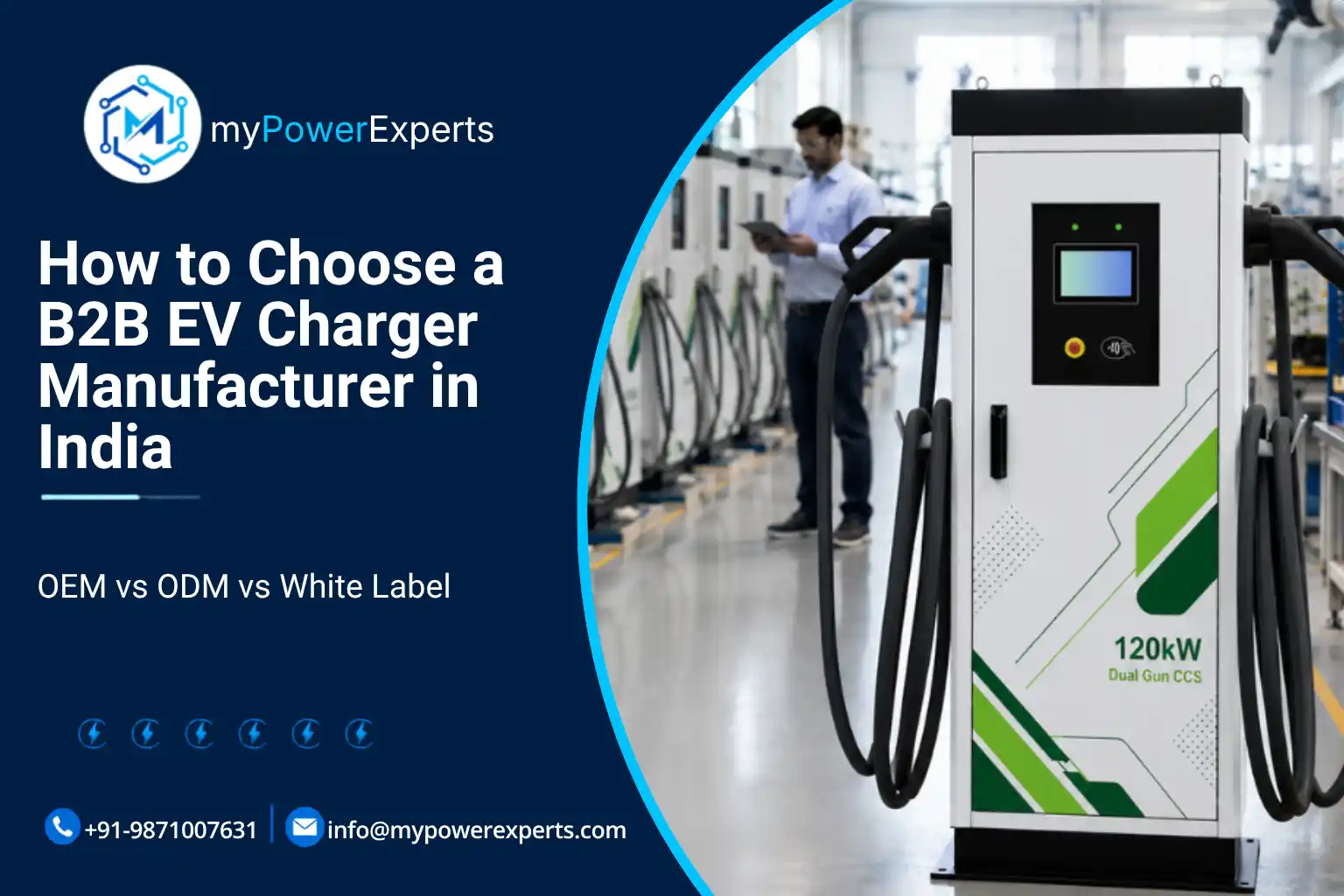
Choosing an EV charger manufacturer is not simply about finding the lowest per-unit price. For distributors, CPOs, fleet operators, infrastructure companies, and businesses building their own charging brand, the manufacturer determines product quality, software compatibility, customization, serviceability, and long-term scalability.
So here is the distinction that changes everything. You are not looking for an EV charger seller. You are looking for a manufacturing partner.
This guide is about evaluating that partner. It covers how OEM, ODM, and white-label actually differ, and the 8 things to check before you commit.
If you are still deciding whether to enter this market at all, start with our guide on launching your own EV charger brand, which covers the opportunity, the economics, and the profitability picture. Once you know you are going ahead, this article helps you choose who to build with.
What Is a B2B EV Charger Manufacturer?
A B2B EV charger manufacturer designs and produces charging hardware for businesses rather than individual consumers. Consequently, the entire relationship works differently from buying a charger online.
How a B2B manufacturer differs from a consumer EV charger seller
The gap shows up in nine practical areas.
1. Bulk procurement
Business buyers order in batches, so pricing, lead times, and logistics work on volume terms rather than single-unit retail.
2. Product customization
A consumer seller ships what exists. A manufacturer, meanwhile, can alter enclosures, power ratings, user interfaces, and firmware.
3. Branding
Manufacturers support your identity on the product, packaging, and documentation.
4. OEM partnerships
Serious manufacturers build long-term supply relationships, including product lines dedicated to a partner.
5. Technical documentation
You get datasheets, test reports, wiring diagrams, and installation manuals rather than a one-page listing.
6. Software integration
A B2B manufacturer helps connect chargers to your chosen management platform.
7. Warranty and support
Business terms cover spare parts, replacement policies, and technical training.
8. Commercial deployment and repeat production
Above all, a manufacturer can supply your pilot batch and then keep supplying as you scale.
In short, a genuine B2B EV charger manufacturer supports your business model, not just your purchase order.
Who Should Work With a B2B EV Charger Manufacturer?
Different buyers need different things from the same partner.
EV charger distributors
Distributors need consistent stock, competitive unit economics, and reliable lead times. Additionally, they benefit from a range wide enough to serve several customer segments, since a single-product catalogue limits their market.
Charge point operators
CPOs care most about uptime, serviceability, and software freedom. Because their revenue depends on chargers actually working, they need remote diagnostics, fast spare-part supply, and compatibility with their existing management system. Our charging solutions for CPOs are built around these priorities.
Fleet operators
Fleets charge on schedule, often overnight and in bulk. Therefore, they need load management, depot-scale planning, and hardware that tolerates daily heavy-duty cycles. Explore our fleet charging solutions for depot deployments.
Automotive and energy companies
These buyers usually want chargers carrying their own brand, integrated into a wider customer experience. Consequently, they lean towards OEM or ODM arrangements rather than off-the-shelf purchases.
Infrastructure developers
Developers building malls, offices, highways, or townships need chargers that fit the site plan, the electrical design, and the local approval process. So flexibility on mounting, power rating, and enclosure matters more than headline speed. Our residential and commercial solutions cover these deployments.
Businesses building their own charger brand
This group needs the most support: product selection, documentation, and after-sales structure all have to come together before the first sale.
OEMs and technology companies
Vehicle makers, energy tech firms, and software companies often need hardware that fits inside a larger product. Accordingly, they need a manufacturer willing to work to a specification rather than sell a catalogue item.
OEM vs ODM vs White Label: The Three Manufacturing Models
This is where most sourcing conversations go wrong, because manufacturers use these terms loosely. Some call everything OEM. Others use white label to mean full customization. So let us define them properly.
| Model | What manufacturer provides | Customization | Best for |
|---|---|---|---|
| Standard | Existing charger, manufacturer’s brand | Low | Distributors, quick deployment |
| White Label | Existing hardware plus your branding | Medium | New brands entering the market |
| OEM | Hardware built to your specification | High | Established businesses with clear requirements |
| ODM | Product development plus manufacturing | Very high | Companies needing a distinct product |
Note that “private label” is the umbrella term. White label, OEM, and ODM all sit underneath it, and all describe a charger made by one company and sold under another’s brand.
8 Things to Check Before Choosing an EV Charger Manufacturer
Use this as your evaluation framework. Each point has caught out real buyers.
1. Actual manufacturing capability
Start here, because the answer shapes everything else. Ask directly: do they manufacture, or do they import and rebrand?
Then dig deeper. Where is the facility? Which components are developed in-house, and which are outsourced? Can you visit? A company that manufactures controls quality, timelines, and design changes. An importer controls none of these, so every problem takes longer to fix.
2. AC and DC charger portfolio
A narrow catalogue limits your business. Look for coverage across the range you might eventually need:
(i). Type 2 AC chargers for cars at homes, offices, and commercial sites
(ii). Bharat AC chargers for cost-sensitive deployments
(iii). Multi-output AC chargers serving two, three, and four-wheelers together
(iv). Portable chargers for bundled or travel use
(v). CCS2 DC chargers for cars and highway sites
(vi). GB/T DC chargers for electric buses and legacy fleets
(vii). BESS-powered DC chargers for sites with weak or constrained grid supply
Our range spans these categories, from AC chargers and portable Type 2 units to DC fast chargers and BESS-operated DC systems.
3. Power ratings
Buyers instinctively reach for the highest kW available. However, the right rating depends on the application, not on ambition.
Sites where vehicles park for hours suit lower-power AC. Highway sites where drivers want twenty minutes suit high-power DC. Consequently, selecting by dwell time and daily traffic protects both your capital cost and your utilisation.
4. Connector compatibility
Your connectors must match the vehicles you serve. In India that means Type 2 for AC charging on cars, CCS2 for DC fast charging, GB/T for many electric buses and Chinese-origin fleets, and Bharat AC for economy deployments. Our guide to CCS2, CHAdeMO and GB/T explains which applies where.
5. OCPP compatibility
This one protects your independence, so treat it as essential rather than a nice extra.
Ask which versions the charger supports, typically OCPP 1.6J or 2.0.1. Then confirm the practical points: can it integrate with your existing management system, does it support remote monitoring and diagnostics, does load management actually work, and can firmware update over the air?
Our full explainer on OCPP and why it matters covers the version differences in detail.
6. Custom branding
Branding runs deeper than a logo sticker. A proper programme covers the logo, enclosure design and colour, the on-device interface, packaging, product labels, and the documentation your customers receive.
7. Production capacity
Your manufacturer needs to handle two different things well: a small pilot order now, and a much larger repeat order later.
Ask what a pilot batch looks like, what lead times apply at different volumes, and what happens if you triple your order.
8. Technical support
Get specifics in writing. Replacement policy, troubleshooting process, spare parts availability and pricing, remote support arrangements, and whether technical training is included for your team or installers.
Why Choose myPowerExperts as Your B2B EV Charger Manufacturer
We work exclusively with businesses, which shapes how we operate.
B2B only
Our model serves distributors, CPOs, fleets, and brand builders rather than retail customers, so we do not compete with our partners for their customers.
White label and OEM support
We supply chargers under your brand, with customization across product, packaging, and documentation.
Complete AC and DC portfolio
Type 2 AC, multi-output AC, portable units, CCS2 and GB/T DC fast chargers, and BESS-operated DC systems, so your range grows with your market.
Made in India
Domestic manufacturing simplifies servicing and spares, and it matters for government-linked projects where domestic manufacturing compliance affects eligibility. Our PM E-DRIVE subsidy guide explains that requirement.
Designed for serviceability
We build for field repair and stock spares locally, because uptime determines your customers’ economics.
Support across the growth curve
Pilot batches through to large repeat orders, so your supplier does not become your ceiling.
Explore the full EV charger range or talk to our team about your requirement.
Conclusion
Choosing a B2B EV charger manufacturer is a decision you live with for years. Price is the easiest factor to compare and the least predictive of success. What actually determines your outcome is manufacturing capability, product range, software openness, serviceability, and the partner’s ability to scale alongside you.