
White Label EV Chargers: Launch Your Own EV Charger Brand
Every petrol pump you see today started as somebody’s bet. Someone looked at a road, counted the cars, and decided fuel was the future. The road has changed. The cars now run on electrons. So the real question is simple: when India plugs in, whose name will sit on the charger?
It does not have to be a Chinese OEM. It does not have to be a giant you can never catch. It can be yours. That promise sits at the heart of the white-label EV charger model, and honestly, the timing right now could not be better.
So let us break down how the white-label route works, why India is the right market at the right moment, and how you can build your own EV charger brand without setting up a single factory.
What is a white-label EV charger, really?
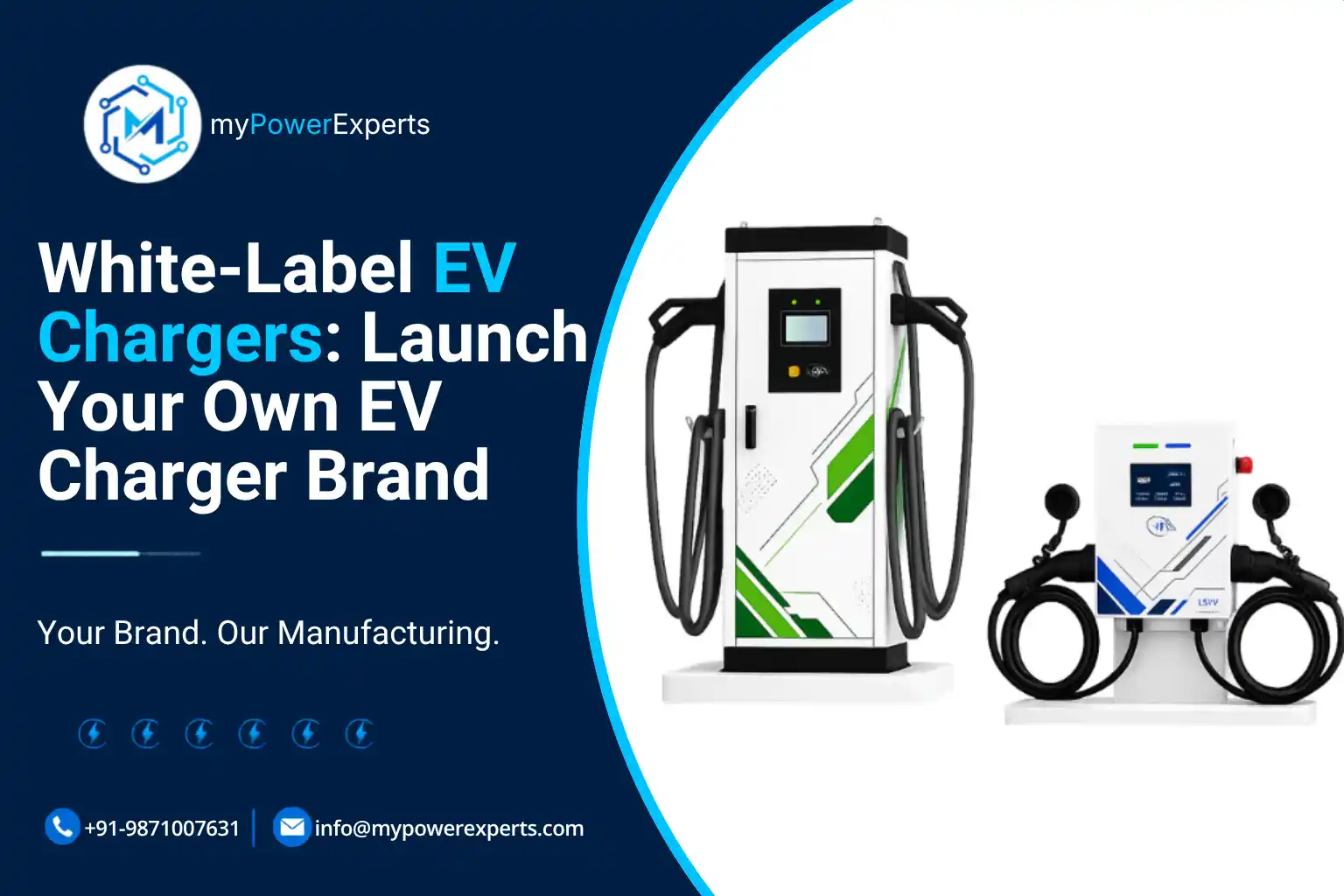
A white-label EV charger is a ready, certified product built by an experienced manufacturer and then sold under your brand name. The maker handles the hardware, the firmware, the testing, and the compliance. You handle the logo, the colours, the marketing, and the customer. Think of it like a clothing label that does not own a tailoring unit. The brand designs and sells, while a trusted partner stitches.
In short, you get a proven charger with your name on the front. Meanwhile, the heavy engineering stays with people who already do it well.
This matters because building a charger from scratch is brutal. First, you need R&D. Then you need component sourcing, design, firmware, and testing. Plus, you need years and serious capital. White label skips all of that. As a result, you reach the market in weeks instead of years, and you carry far less risk if you ever need to pivot.
Why India is the smartest place to do this in 2026
Here is where the story gets exciting. India is not slowly warming up to EVs anymore. It has already crossed the tipping point.
In 2025, India sold over 2.27 million electric vehicles, the highest ever recorded across all segments, growing 16.3% over the previous year. EVs now make up roughly 8% of all new vehicles sold in the country. Then the momentum only grew. Across FY2026, India crossed 2.45 million EV sales, with penetration climbing to 8.27%, and March 2026 alone delivered a record 280,093 units in a single month.
Notice the shift in four-wheelers too. Electric car registrations jumped nearly 77% in 2025. Clearly, the people who will need fast charging on highways and in cities are arriving fast.
The government is not sitting quietly either. India targets 30% EV penetration in private cars by 2030, which works out to roughly 80 million electric vehicles on the road. That is not a forecast you can ignore. That is a wave you can ride.
The gap that becomes your opportunity
Now for the part that should make you sit up. India had about 27,737 public charging stations installed by March 2026, with around 22,753 actually operational. Even counting semi-public points, the number sits near 29,000 to 39,500.
Sounds large? It is not. Three years ago, India had barely 5,000 public chargers, so the network has grown almost six times. Yet adoption has grown faster. Today, the country runs at roughly one charger for every 225 to 235 EVs, while the healthy global benchmark is one charger for every 6 to 20.
And the projection is staggering. To support its 2030 goals, India will need an estimated 1.32 million public charging stations, which is more than 40 times the current installed base.
So read that again. Vehicles are flooding in. Chargers are lagging far behind. That mismatch is not a problem for you. Honestly, it is the single biggest open business gap in Indian mobility right now.
White label vs building from scratch vs franchise
Most people compare only two options. Actually, you have three. Let us put them side by side, because the difference decides your margins for the next decade.
| Path | What you do | The catch |
|---|---|---|
| Build from scratch | Design and manufacture your own charger | Heavy capital, long timelines, high failure risk |
| Buy a franchise | Sell under someone else’s national brand | Steep fees, fixed pricing, little control, you build their name |
| White label | Take chargers in your own brand | You own the brand, the margin, and the customer |
The franchise route looks safe at first. However, the fees have climbed sharply, and you often lose control over pricing and operations. Worse, every customer you win strengthens someone else’s brand, not yours.
White label flips that. You keep the brand equity. You set your positioning. Plus, you decide who your customers are, whether that is dealerships, builders, malls, housing societies, or fleet operators. In other words, you stop renting a name and start owning one.
This is exactly the line myPowerExperts takes with a sharp slogan: stop building other people’s brand and build your own.
Why “Made in India” white label beats imported chargers
Here is a trap many new brands fall into. They import cheap chargers, slap a sticker on them, and hope for the best. Then a board fails, and they discover the painful truth. The part is not available, the firmware is locked, and the support sits across a sea and a language barrier.
When someone thinks of manufacturing an EV charger, over 90% of the components usually come from China. That is a fragile foundation for a brand you want to last.
A Made-in-India partner solves this. The Delhi-NCR startup myPowerExperts builds chargers that are Made in India, with a clear focus on repairability and local support. So when something needs fixing, it gets fixed quickly, in your timezone, in your language. As a result, your brand earns a reputation for reliability instead of headaches.
That reliability becomes your moat. After all, in this business, uptime is everything.
The products that make up your brand
A real charging brand needs a full shelf, not one product. Fortunately, a strong white-label partner gives you the complete range. Here is what your lineup can include, drawn from the myPowerExperts product range:
- Type 2 AC chargers for homes, offices, and residential societies, ideal where cars park for a few hours.
- Multi-output AC chargers that charge two-wheelers, three-wheelers, and four-wheelers together, perfect for commercial spots.
- Portable AC chargers that drivers carry inside the car for emergency top-ups anywhere.
- DC fast chargers from 30kW wallbox units up to 60kW and 120kW single and dual-gun stations for highways, malls, and hubs.
- DC ultra-fast Chargers for buses and trucks, ratings up to 360 kW.
- DC-DC EV Chargers for operation with BESS. Solar and Vehicle Mounted applications.
Notice the spread. AC units give you steady, low-cost coverage. DC units pull in high-traffic revenue. Together, they let you serve every kind of customer under one name.
How to launch your own EV charger brand: a step-by-step roadmap
Here is the practical path from idea to live brand.
Step 1: Pick your niche and your customer
First, decide who you serve. Will you sell chargers to housing societies and builders? Or will you run your own branded charging stations on highways? Maybe both. Your niche shapes everything that follows, so choose with intent.
Step 2: Choose a white label manufacturing partner
Next, this is the decision that makes or breaks you. Look for a partner with a Made-in-India supply chain, a full AC and DC range, and genuine after-sales support. Speak to their team and ask hard questions about repairs.
Step 3: Lock your compliance and certification
Take the Chargers in your Brand name and design from myPowerExperts and get them type-tested at the designated NABL Labs / ARAI / iCAT. They support you in the certification process from Start to End.
Step 4: Build your brand identity
Design your logo, choose your colours, name your app, and define your tone. Because the chargers are white-label so your customer sees you everywhere, never the manufacturer.
Step 5: Set up your sales channels
Then decide how you sell. Many brands start B2B, targeting dealerships, property developers, fleet operators, and commercial sites. Others go B2C with direct sales and installation. You can run both. Either way, your branded CMS and app keep customers inside your ecosystem.
Step 6: Tap into government support
Under the PM E-DRIVE scheme, India has earmarked around ₹2,000 crore for charging infrastructure and a target of 72,300 stations. Certain public-access setups can claim heavy subsidies on upstream infrastructure. State EV policies add more on top. So check your state scheme before you invest.
Is the EV charger business actually profitable?
Now let us get into the actual figures, because hype means nothing until the maths holds up.
Profit margins on EV charging operations typically range from 15% to 30%, and premium highway or fleet locations can push margins toward 50%. Meanwhile, return on investment usually lands within 18 to 36 months at well-chosen sites.
The entry cost is also friendlier than people assume. A small AC charging setup needs only a modest start, whereas DC fast chargers ask for heavier capital yet bring in much more from every single session. Better still, EV charging needs no special licence in India; the sector is de-licensed, and concessional electricity tariffs are often available.
Two factors decide your success more than anything else. First, location, because footfall drives utilisation. Second, utilisation, because an empty charger earns nothing while a busy one prints money. So pick sites where vehicles already gather and stay.
Why myPowerExperts for your white label journey
You have plenty of options in this space, but only myPowerExperts will never compete with you for your customers because they do not sell Chargers under their Brand Name. So, for someone who wants to own a Made-in-India brand without the factory headache, the case for myPowerExperts is straightforward.
It is an Indian startup built for exactly this purpose. The chargers are made in India and designed to be repairable. The range covers AC, DC, portable, and CMS, so your brand launches complete. The team has a strong field installation base across the country. Plus, the company offers end-to-end help, whether you have land for a station, want to sell chargers under your name, or simply want to enter the EV space without knowing the ecosystem yet.
In short, it removes the technical risk so you can focus on the brand. That is the whole point of going white label.
The road ahead is open. The question is whether you take it
Every big market has a short window when the door is wide open. India’s charging market is in that window right now. The vehicles are here. The chargers are not. The government is paying people to build them. And the brands that plant their flag today will own the highways of tomorrow.
You do not need a factory. You do not need years of R&D. You need a clear niche, a trusted Made-in-India partner, and the will to put your own name on the future.
So stop building someone else’s brand. Build your own.
“Ready to launch your EV charger brand? Talk to the myPowerExperts team and start taking AC and DC chargers in your own name.”
FAQs
1. What is a white-label EV charger?
It is an EV charger made by one company and sold under your brand name, so you skip manufacturing and own the branding.
2. How do I start my own EV charger brand in India?
Pick your niche, choose a white label partner, build your branding, and set up your sales channels and CMS.
3. Is the EV charger business profitable in India?
Yes, margins usually run 15% to 30%, and good locations recover the investment in roughly 18 to 36 months.
4. What is the difference between white label and a franchise?
With white-label, you own the brand and margins, while a franchise makes you sell and build someone else’s name for a fee.
5. How much does it cost to start a white-label EV charger business?
Costs vary by charger mix, with small AC setups starting modestly and DC fast-charging stations needing higher capital but earning more.