Dual Gun LEVDC Chargers: Double Your Light EV Charging Throughput
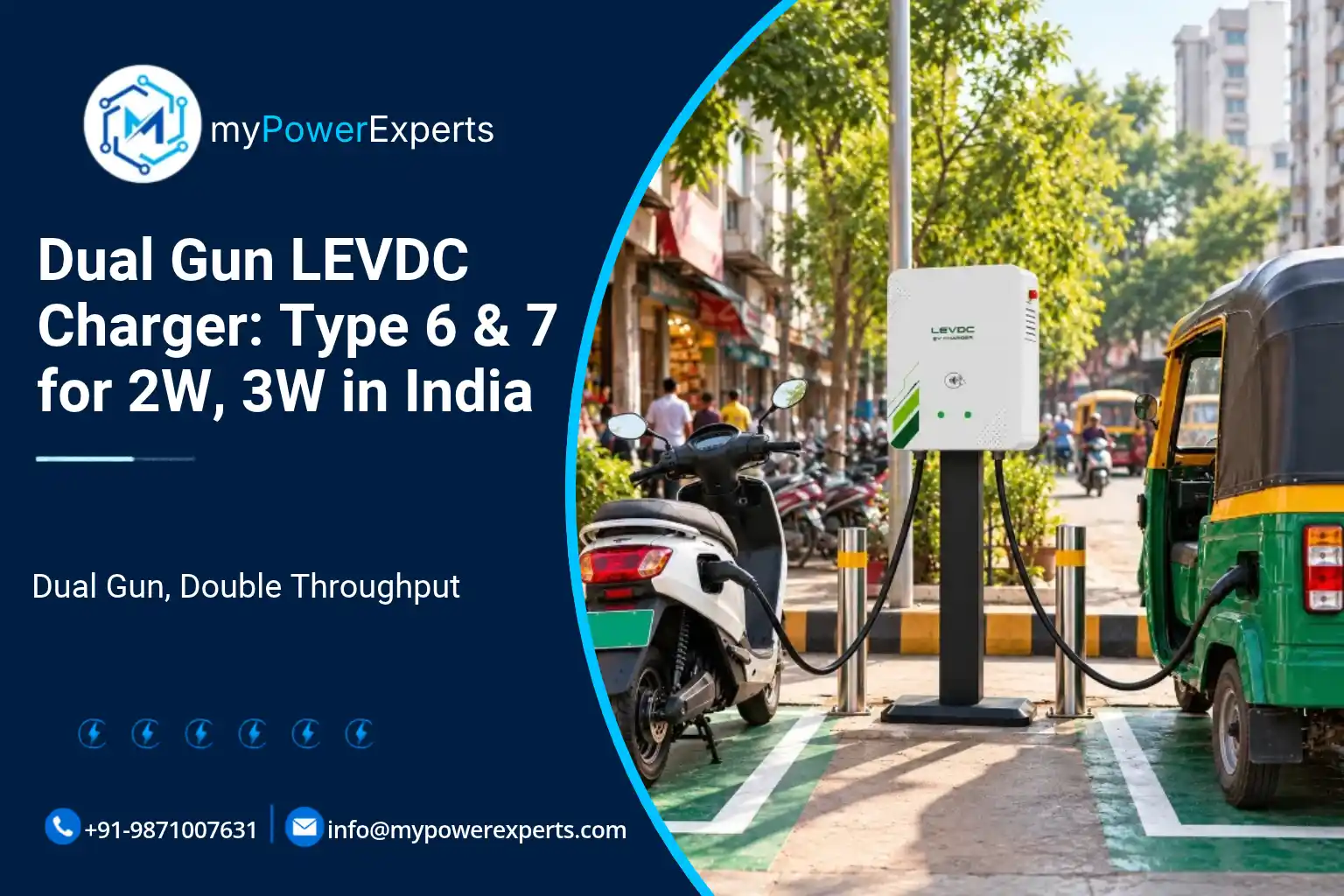
A single-gun LEVDC charger serves one scooter at a time. At a busy market or a delivery hub, that means a queue by mid-morning, riders leaving for a competitor, and a charger sitting idle the moment its one customer unplugs.
Dual gun LEVDC chargers fix that arithmetic. One unit, one grid connection, one foundation, two vehicles charging at once.
Demand for these has climbed sharply, and the reason is straightforward: India’s light EV segment is where the charging volume actually is, and operators have worked out that throughput per site matters more than raw power.
What LEVDC Actually Means
LEVDC stands for Light Electric Vehicle DC charging. It covers DC fast charging for electric two-wheelers, three-wheelers, and e-rickshaws, which need far lower voltage than cars.
Two connector standards matter in India, and both sit under IS 17017.
| Specification | Type 6 (LEVDC) | Type 7 (LECCS) |
|---|---|---|
| Standard | IS 17017-2-6 | IS 17017-2-7 |
| Charging | DC only | Combined AC and DC |
| Max voltage | 120 V DC | 120 V DC |
| Max current | 125 A DC | 100 A DC |
| AC capability | None | Up to 7 kW |
| Latch location | Charger side | Vehicle side |
Type 6 is recognized internationally as IEC 62196-6. Type 7 (LECCS), published by BIS, has been adopted by major Indian OEMs including Ather and Hero MotoCorp.
Dual Gun: Simultaneous, Not Power Shared
This distinction decides whether a dual-gun charger actually earns its price, and most buyers miss it.
Many dual-gun DC chargers share a single power pool.
Our LEVDC units work differently. Both guns deliver their rated output at the same time, without splitting a shared pool. Two vehicles charge at full speed together, so the second gun genuinely doubles what the site can serve per hour.
The Throughput Maths
Light EV charging is a volume business, so sessions per day drive everything.
A 12 kW LEVDC charger typically takes a scooter from 20 to 80 percent in around 20 minutes. An e-rickshaw takes closer to an hour. Working on a 30-minute average session and a 10-hour operating day:
- Single-Gun Unit: Serves ~20 vehicles/day.
- True Dual-Gun Unit: Serves ~40 vehicles/day.
The cost side barely moves. You pay for one enclosure, one electrical connection, one civil foundation, one OCPP subscription, and one service visit when something needs attention. Revenue potential doubles while fixed costs stay close to flat, which is why payback on dual gun configurations tends to be materially shorter.
Site footprint matters too. Urban charging locations in India are short on space, and two pedestals need roughly twice the floor area plus a second cable run. One dual gun pedestal fits where a single unit fits.
Where Dual Gun LEVDC Fits Best
High turnover sites gain the most:
1. Market areas and commercial streets
2. Delivery and gig fleet hubs
3. E-rickshaw stands and transport hubs
4. Residential societies and workplaces
5. Retail and hospitality parking
Our Dual Gun LEVDC Charger
myPowerExperts manufactures LEVDC fast chargers in India for operators entering the light EV segment.
- Power options: 3 kW, 6 kW, and 12 kW
- Configuration: single or dual gun, with both guns charging simultaneously rather than sharing power
- Connectors: Type 6 (LEVDC) and Type 7 (LECCS) supported
- Vehicles: electric two-wheelers, three-wheelers and e-rickshaws
- Mounting: compact wall or pedestal for tight urban sites
- Software: OCPP-enabled with RFID, smart connectivity, and a full protection suite
Market pricing for dual-gun LEVDC units broadly runs from about ₹1 lakh to ₹2 lakh depending on power rating and configuration, though volume and specification change that considerably.
See the full specification on our DC charger page, or enquire about LEVDC Type 6/7 units for pricing on your configuration.
Conclusion
Light EV charging rewards throughput, not headline power. A 12 kW dual gun unit that charges two vehicles simultaneously will out-earn a larger single-gun charger at almost any busy urban site, because the constraint is how many riders you serve per hour rather than how fast you serve any one of them.
Frequently Asked Questions
1. What is a LEVDC charger?
A DC charger for light electric vehicles, covering electric two-wheelers, three-wheelers, and e-rickshaws.
2. What is the difference between Type 6 and Type 7?
Type 6 (IS 17017-2-6) is DC only. Type 7, or LECCS (IS 17017-2-7), combines AC and DC in one port, supporting up to 7 kW AC and 12 kW DC.
3. Does a dual gun charger split its power?
It depends on the unit. Many share one power pool, so each gun delivers half when both are in use. Our LEVDC chargers deliver rated output on both guns simultaneously.
4. How long does a 12 kW LEVDC charger take?
A scooter typically reaches 20 to 80 percent in around 20 minutes. An e-rickshaw, with a larger pack, usually takes closer to an hour.

Explore Related Articles