
CCS2 vs CHAdeMO vs GB/T: What’s the Difference?
If you plan to set up an EV charging station or launch your own charger brand in India, the connector question comes up almost immediately. CCS2, CHAdeMO, and GB/T all promise fast DC charging. However, they are not interchangeable, and picking the wrong one can strand vehicles and sink your return on investment.
So let us clear the confusion in plain language. Below, we break down what each standard actually is, how they differ, and, most importantly, which one your charging business should back in the Indian market today.
The Quick Answer First
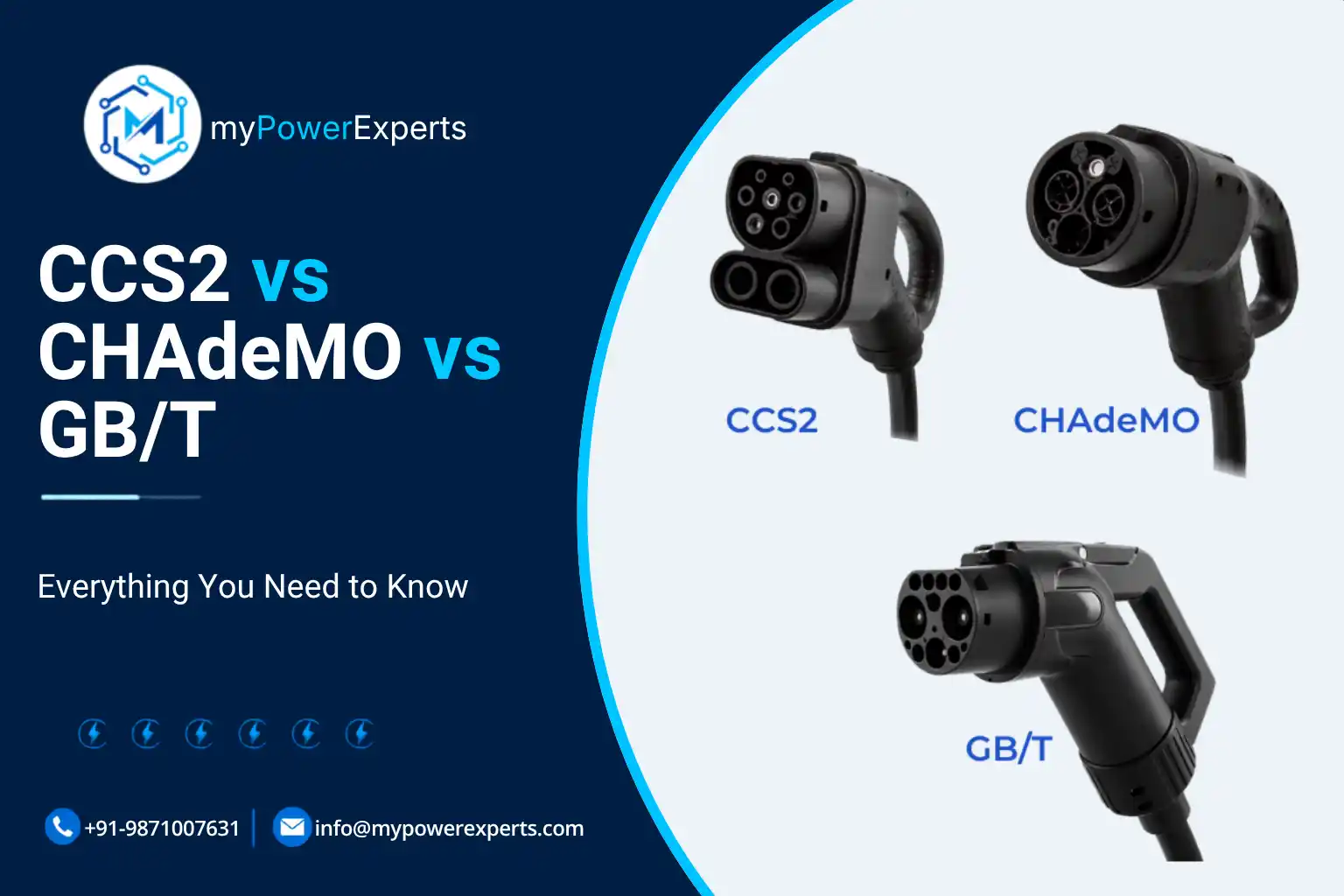
Before we dig into the details, here is the short version. CCS2 is the DC fast-charging standard that India, Europe, and most of the world now use for cars. CHAdeMO is an older Japanese standard that is fading fast. GB/T is China’s national standard, and in India, it mainly powers electric buses and some legacy fleets.
In other words, for a modern four-wheeler charging station in India, CCS2 is the default choice. Still, GB/T and CHAdeMO matter in specific situations, so let us look at each one closely.
What Is CCS2?
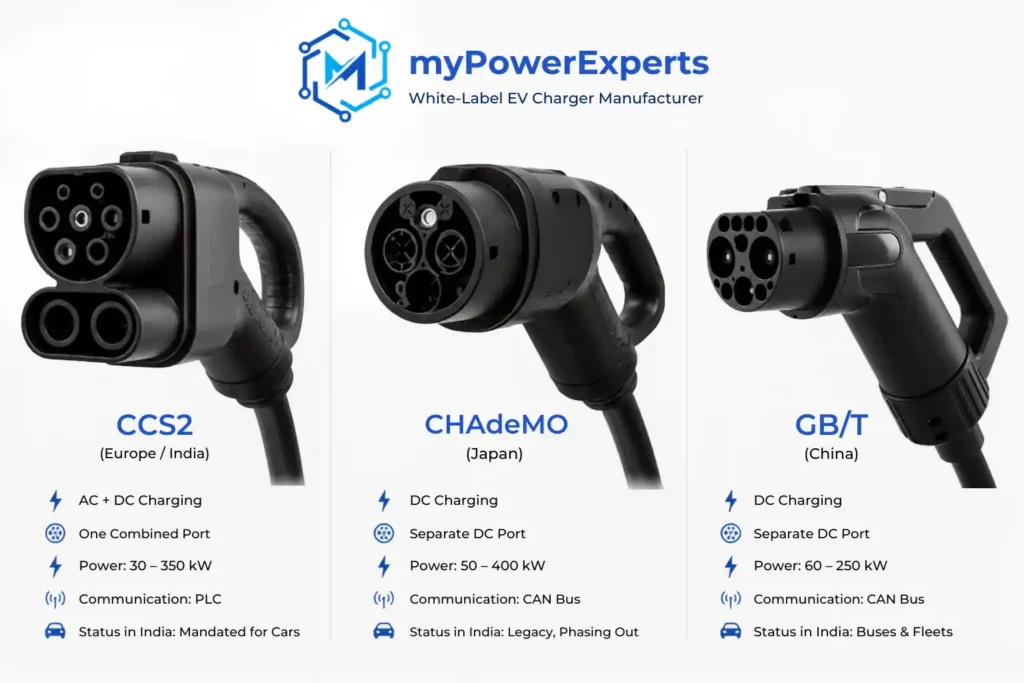
CCS stands for Combined Charging System. Essentially, it merges AC and DC charging into one single connector, which is why it is so popular. The “2” refers to the version built on the European Type 2 plug, while CCS1 uses the American Type 1 plug.
Here is the clever part. A CCS2 inlet looks like a Type 2 socket with two large DC pins added underneath. As a result, one port on the car handles both slow AC charging at home and high-speed DC charging on the highway. For drivers, that means a single port for everything. For manufacturers, it simplifies vehicle design.
Technically, CCS2 supports up to 1000 volts and around 500 amps with liquid-cooled cables. In practice, though, most Indian DC fast chargers deliver between 30 kW and 120 kW, while premium networks are now rolling out 150 kW to 350 kW stations. Consequently, nearly every modern EV sold in India, from the Tata Nexon EV and MG Windsor to the BYD Seal, Hyundai Creta EV, and Mahindra BE 6, charges on CCS2.
What Is CHAdeMO?
Japan developed CHAdeMO back in 2010, and for a while it was one of the first commercially viable DC fast-charging systems in the world. The name is a playful shortening of “CHArge de MOve.” Unlike CCS2, it uses a completely separate DC connector, so the car needs a dedicated inlet plus a separate AC port.
CHAdeMO does have one genuine strength: bidirectional charging. In fact, it pioneered vehicle-to-grid and vehicle-to-home features, which let a car feed power back into a building or the grid. Newer versions push power quite high, too.
That said, CHAdeMO is clearly declining. Globally, automakers have moved to CCS, and even Nissan, its biggest champion, switched its newer EVs away from it. In India, only a handful of older Japanese models ever used it, and today it is rarely seen on new vehicles. Therefore, for most Indian charging businesses, CHAdeMO is now a legacy consideration rather than a core requirement.
What Is GB/T?
GB/T is China’s national charging standard. GB stands for “Guobiao,” which simply means national standard. Unlike CCS2, GB/T keeps AC and DC on separate connectors. The AC plug is oval with seven pins, while the DC plug uses thick pins in a rectangular housing.
Now here is where it gets interesting for India. GB/T is not compatible with CCS2. A GB/T gun will not fit a Tata, MG, or Mahindra car, and a CCS2 gun will not fit a GB/T vehicle. They use different shapes and different communication protocols entirely.
Even so, GB/T is far from dead in India. Many electric buses, especially BYD and Olectra fleets, run on GB/T. Additionally, some early fleet vehicles and certain Chinese-made EVs still use it. Government-era chargers installed under older schemes sometimes carry GB/T or Bharat DC-001 guns as well. So if your business targets bus depots or mixed commercial fleets, GB/T stays firmly on the table.
CCS2 vs CHAdeMO vs GB/T: Side-by-Side Comparison
| Feature | CCS2 | CHAdeMO | GB/T |
|---|---|---|---|
| Origin | Europe | Japan | China |
| AC + DC in one port | Yes | No (separate ports) | No (separate ports) |
| Typical DC power | 30 to 350 kW | 50 to 400 kW | 60 to 250 kW |
| Communication | PLC | CAN bus | CAN bus |
| Bidirectional (V2G) | Emerging | Yes, mature | Yes |
| India status | Mandated for cars | Legacy, phasing out | Buses and legacy fleets |
| Best for | Cars, highway hubs | Older imports | E-buses, Chinese fleets |
Why the Communication Protocol Matters
Most guides stop at the connector shape, yet the real difference runs deeper. Each standard “talks” to the vehicle differently. Specifically, CCS2 uses PLC (power line communication) over the cable, whereas both CHAdeMO and GB/T use CAN bus messaging.
These protocols are not naturally compatible. As a result, a single charger cannot simply serve every vehicle without extra hardware and software stacks. For a Charge Point Operator, this is a real cost driver. In short, supporting multiple standards at one site means multiple guns, more electronics, and higher maintenance. That is exactly why understanding the mix upfront saves money later.
Where India Officially Stands
India has firmly picked its winners, and this matters for compliance. The Bureau of Indian Standards, through IS 17017, and the Ministry of Power guidelines have set clear rules.
- For four-wheelers, CCS2 (IS 17017-2-3) is the prescribed DC standard, covering 50 kW to 250 kW.
- For heavy-duty e-buses and trucks, the guidelines specify high-power CCS2 chargers between 250 kW and 500 kW, with a minimum of 120 kW per gun.
- Two- and three-wheelers use Light EV DC (Type 6) and Light EV AC/DC Combo (Type 7) connectors up to 12 kW.
On top of that, all networked chargers must support OCPP 2.0.1 for backend communication and OCPI for roaming.
Which Connector Should Your Business Back?
Now for the question that actually pays your bills. As a charging business, you should not pick a standard emotionally. Instead, match the connector to the site and the vehicles it will serve. Here is a practical way to think about it.
1. Highway and city car hubs
Go with CCS2, full stop. Since virtually every passenger EV in India uses it, CCS2 gives you the widest customer base and future-proof compliance.
2. Bus depots and commercial fleets
Check the fleet first. Many e-bus fleets run GB/T, so a GB/T DC charger or a multi-standard setup often makes sense here.
3. Two- and three-wheeler hubs
Focus on Bharat AC-001, LEV DC (Type 6), and LEV AC/DC (Type 7). Do not overbuy high-power DC that these small batteries cannot use.
4. Mixed or transitional sites
Consider multi-gun chargers. For example, a station serving both cars and a few older imports might offer CCS2 plus GB/T or CHAdeMO, so no vehicle gets stranded.
Ultimately, the smart move is to start from your customer base and work backward to the hardware, not the other way around.
How to Choose the Right Charger for Your Brand
Choosing between CCS2, CHAdeMO, and GB/T ultimately comes down to three questions. First, who are your customers, whether cars, buses, or light EVs? Second, what does Indian regulation require for that segment? Third, what power level does the site actually need?
Once you answer those, sourcing the right hardware becomes simple, especially when you partner with a manufacturer who understands the Indian market end-to-end. At myPowerExperts, we manufacture white-label AC and DC chargers, including Type 2 AC, CCS2 DC fast chargers, and GB/T DC chargers, and we supply them under your own brand name. In addition, we help you set up your charging station or hub with complete, end-to-end support.
So whether you want to launch a white-label charger brand or build a charging network, talk to our team and explore our full product range to find the connector mix that fits your business.
Conclusion
To sum up, CCS2, CHAdeMO, and GB/T solve the same problem in three different ways. CCS2 has won the Indian passenger-car market and enjoys full regulatory backing. CHAdeMO is fading into legacy status. GB/T, meanwhile, still powers a meaningful slice of buses and commercial fleets.
For any Indian charging business, the strategy is straightforward. Lead with CCS2 for cars, plan GB/T or multi-standard support where fleets demand it. Get that right, and your charging venture stays ready for whatever the road ahead brings.
Frequently Asked Questions
1. Is CHAdeMO still used in India?
Rarely. Only a few older Japanese models ever used CHAdeMO in India, and new EVs have almost entirely dropped it in favor of CCS2.
2. Can I use a CCS2 charger on a GB/T vehicle?
No. CCS2 and GB/T use different connector shapes and different communication protocols, so they are not compatible without a certified adapter.
3. Which EV charging standard is best for India?
For four-wheelers, CCS2 is the best and officially mandated choice. It combines AC and DC in one port, supports high power, and works with almost every modern car sold in India. For light EVs, the Bharat and Type 6 or Type 7 standards apply instead.
4. What is the difference between CCS2 and Type 2?
Type 2 handles only AC charging, while CCS2 adds two extra DC pins below the Type 2 section for fast DC charging.
5. Is GB/T faster than CCS2?
Not really. In practice, GB/T DC commonly reaches up to around 250 kW, while CCS2 can scale to 350 kW and beyond with high-power stations.
6. Will there ever be one universal EV charging standard?
Possibly, but not soon. Regions are slowly converging, and projects like ChaoJi aim to merge CHAdeMO and GB/T for ultra-fast Asian charging. For now, though, multiple standards coexist, so multi-standard chargers and adapters remain important.